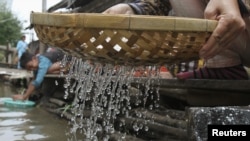
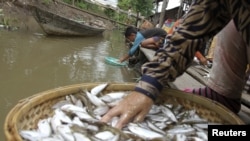
People clean fish on the Mekong riverbank in Phnom Penh December 9, 2011.
BANGKOK — One of the world’s largest environmental groups has released its latest study of freshwater biodiversity in Southeast Asia, where hydroelectric dams and development threaten fish and aquatic life. It is the first-ever detailed survey of some parts of the Mekong river.
The four-year study by the International Union for the Conservation of Nature (IUCN) reveals growing rates of freshwater species under threat in the Southeast Asia region known as IndoBurma, with at least 13 percent of the more than 2,500 species facing extinction.
The Indo-Burma region covers Thailand, the western region of Burma - also known as Myanmar - Laos, Cambodia and Vietnam and is based on the ecology and species distribution outside national borders.
The region is known as a ‘hotspot” by IUCN scientists for species largely not found elsewhere and under threat.
The IUCN says freshwater species now face increasing threats from reduced water volumes and quality, pollution, over-exploitation, dams and flow regulation, climate change and “invasive” alien species to the waterways.
Robert Mather, head of the IUCN’s Southeast Asia Group, says the findings raise concerns for freshwater fish, mollusks and crabs - which are key food sources for millions of people.
“For fish we looked at almost 1,200 species and we found 21 critically endangered and 39 endangered and 52 vulnerable," Mather explained. "So for fish around 16.9 percent are threatened, for mollusks, around 16.6 percent. For freshwater crabs almost a third of all species are threatened - 33.8 percent.”
People clean fish on the Mekong riverbank in Phnom Penh December 9, 2011.
In Cambodia’s Ton Le Sap Lake, research found that, although the total catch by weight had doubled in 50 years, the region’s human population had tripled and fish stocks are showing signs of depletion.
The IUCN also studied a 450-kilometer stretch of the Mekong River in Laos where scientists recorded 23 sightings of Lao flora not previously noted. Raphael Glement, an IUCN representative in Laos, says since the last study 12 years ago scientists found a sharp decline in biodiversity and forest habitat now with little evidence of primary evergreen forest.
“So the diversity and the evidence seems to be significantly lower than 12 years ago," noted Glement. "So again I’m comparing a two-day survey in 2004 to a 25 [day] survey in 2012. But, we can already identify that, for most of the birds, the population decreased or some birds disappear from this part of the river. The birds are good indicators of the quality of the environment They will be the first ones affected. So here is really clear.”
The IUCN says a key concern is plans for construction of hydropower dams on the lower Mekong. The Lao government last December had agreed to halt construction of the $3.8 billion Xayaburi Hydropower plant pending, further environmental assessments. But recent reports indicate construction has resumed on the plant that is expected to sell electricity to Thailand.
Mather says plans to proceed with up to 10 planned dams on the Lower Mekong could have a major impact on biodiversity.
“At the end of the day, the direct impacts of the Xayaburi Dam alone on food security are probably not going to be massive," Mather said. "But if you see the Xayaburi as the first in a whole cascade of dams that will be built on the Lower Mekong mainstream and the cumulative effects of these dams together - then the effect will be really massive on the food security.”
The IUCN warns that, in the next decade, the proportion of fish species threatened by the dams is predicted to rise from 19 percent to almost a third.
Environmental groups have called on Laos to stand by earlier calls for a 10-year moratorium on the Xayaburi Dam’s construction so a full evaluation of the impact on the biodiversity of the region can by fully assessed.