



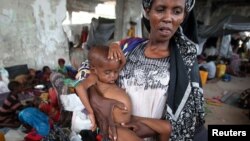
NAIROBI - Despite impressive economic growth rates across Africa, many of the continent’s people remain food insecure. That is the major finding of Africa’s first Human Development Report, released Tuesday in Kenya’s capital.
In the lead-up to the report’s launch, Kenyan President Mwai Kibaki painted a grim picture of his continent’s food security situation.
“Sub-Saharan Africa is most affected, with an estimated 239 million people, representing 30 percent of the population, suffering from chronic hunger and malnutrition - 30 percent," the president declared. "Moreover, in the same region, about 38 percent of children below five years are stunted due to the effects of chronic malnutrition.”
Economic growth
Meanwhile, African economies have been growing at rates of more than five percent - among the world's highest - since 2010 and are projected to continue the trend.
The irony is not lost on the report’s author, Tegegnework Gettu, director of the United Nations Development Program’s Africa regional bureau.
He calls it a “harsh paradox” that sub-Saharan Africa is food insecure when the continent has ample fertile land, substantial amounts of surface and underground water, and the ideal climate to grow crops.
He says that misguided policies, lack of political commitment, and weak institutions are what he calls the “deeper cause” of food insecurity.
“History is not destiny," noted Gettu. "These experts, these researchers conclude that Africans are not destined to starve. It is solvable with a certain period of time, provided that governments move decisively to put in place appropriate policies and support mechanisms.”
Report theme
The first-ever African Human Development Report 2012 was released in Kenya’s capital Tuesday. The theme of the inaugural report is “Towards a Food Secure Future.” The report defines food insecurity as the inability to consistently get enough calories and nutrients for a healthy and productive life.
It says that agricultural productivity in Africa remains much lower than in other parts of the world. Even when food is available, millions cannot afford to purchase that food.
Women and the rural poor - who are the major food producers - are often discriminated against, says the report.
Recommendations
To improve food security across the continent, the report recommends that governments implement policies in four areas.
The first is to boost small farmers’ productivity by giving them access to improved seeds and fertilizers, extension services, new technologies, and credit.
A second goal is to improve nutrition by educating people - especially girls and those living in isolated areas - about what to eat.
A third area is building resilience for individuals and communities by offering social safety nets, crop insurance, food-for-work programs, repairing degraded environments, and other initiatives.
Fourthly, the report recommends that women and other marginalized people be given more access to land, decision-making, and other rights.
In the lead-up to the report’s launch, Kenyan President Mwai Kibaki painted a grim picture of his continent’s food security situation.
“Sub-Saharan Africa is most affected, with an estimated 239 million people, representing 30 percent of the population, suffering from chronic hunger and malnutrition - 30 percent," the president declared. "Moreover, in the same region, about 38 percent of children below five years are stunted due to the effects of chronic malnutrition.”
Economic growth
Meanwhile, African economies have been growing at rates of more than five percent - among the world's highest - since 2010 and are projected to continue the trend.
The irony is not lost on the report’s author, Tegegnework Gettu, director of the United Nations Development Program’s Africa regional bureau.
He calls it a “harsh paradox” that sub-Saharan Africa is food insecure when the continent has ample fertile land, substantial amounts of surface and underground water, and the ideal climate to grow crops.
He says that misguided policies, lack of political commitment, and weak institutions are what he calls the “deeper cause” of food insecurity.
“History is not destiny," noted Gettu. "These experts, these researchers conclude that Africans are not destined to starve. It is solvable with a certain period of time, provided that governments move decisively to put in place appropriate policies and support mechanisms.”
Report theme
The first-ever African Human Development Report 2012 was released in Kenya’s capital Tuesday. The theme of the inaugural report is “Towards a Food Secure Future.” The report defines food insecurity as the inability to consistently get enough calories and nutrients for a healthy and productive life.
It says that agricultural productivity in Africa remains much lower than in other parts of the world. Even when food is available, millions cannot afford to purchase that food.
Women and the rural poor - who are the major food producers - are often discriminated against, says the report.
Recommendations
To improve food security across the continent, the report recommends that governments implement policies in four areas.
The first is to boost small farmers’ productivity by giving them access to improved seeds and fertilizers, extension services, new technologies, and credit.
A second goal is to improve nutrition by educating people - especially girls and those living in isolated areas - about what to eat.
A third area is building resilience for individuals and communities by offering social safety nets, crop insurance, food-for-work programs, repairing degraded environments, and other initiatives.
Fourthly, the report recommends that women and other marginalized people be given more access to land, decision-making, and other rights.