



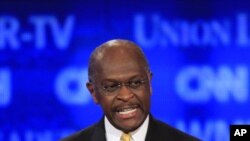
Some candidates for the U.S. presidential election next year have been making statements about Islam and its American adherents that are stirring controversy. Civil rights groups warn that the candidates are pushing anti-Muslim views into the mainstream.
Candidate - Cain views
No one has gone as far as Herman Cain. The former chairman of a pizza chain was one of the lesser known Republican candidates - that is, until a few months ago - when he said that, if he was president, he would not like to have a Muslim working for him. At a debate in New Hampshire several weeks ago, Cain said that would make him uncomfortable. "And I would not be comfortable because you have peaceful Muslims and then you have militant Muslims, those that are trying to kill us," he said.
Cain denied that he is anti-Muslim, but he argued that a Muslim applying to work in his administration would be subject to a different level of screening than someone of another faith. Another republican candidate, Newt Gingrich, suggested during the New Hampshire Republican debate that Muslims seeking a job in an administration he leads would be subject to special loyalty tests.
Candidate - Gingrich views
“Now, I just want to go out on a limb here. I'm in favor of saying to people, 'If you're not prepared to be loyal to the United States, you will not serve in my administration, period," Gingrich stated.
Critics say such views are discriminatory. One such critic is Haris Tarin of the Muslim Public Affairs Council. "... what they're doing is they're trying to use an issue that most Americans don't know about to try to instigate curiosity so that people can potentially vote for them," he said.
Not all the candidates single out Muslims in this way. Mitt Romney, the Republican front runner so far, recalled at the debate that America was founded on the principle of religious tolerance. Romney belongs to the Mormon faith, which some evangelical Christians consider to be heretical.
Views, from the fringes to mainstream
Tarin is concerned that anti-Muslim views could become more acceptable to the broader public after being aired during a debate among presidential candidates on the Cable News Network, CNN.
"We're very worried, because these views have been consistently found in the fringes. Now they're being viewed on CNN and debated on a nationally televised debate of Republican nominees. And so when it moves from the fringes to the homes of mainstream America we get very worried," Tarin noted.
There is evidence that may already be happening. A recent report on Islamophobia by the Council on American-Islamic Relations cited a 2010 poll which found that one-third of Americans believe adherents of Islam should not be allowed to run for president.
The issue got further attention when Congress’ House Committee on Homeland Security conducted hearings in March and again this month on al-Qaida’s reported attempts to recruit followers among the Muslim-American community. The committee chairman, Republican Peter King of New York, said the hearings were necessary to protect America from terrorist attack.
And according to the Muslim Public Affairs Council and the American Civil Liberties Union, at least 25 state legislatures are considering proposals aimed at banning the Muslim Sharia code of law from being cited in U.S. courts.
9/11 terror attacks, plots - American views changing
Anti-foreigner sentiment has come and gone in America because of its development over the centuries as a nation of immigrants.
Steve Grand is a Middle East expert at the Brookings Institution."There's a long tradition in the United States, unfortunately, of fearing the unknown and fearing those who seem different from us," he said. "And then eventually we come to know and understand those people and they become part of the American mainstream and American culture."
But 10 years after al-Qaida’s 9-11 terror attacks in New York and several foiled terror plots since then, the prospects for Muslim Americans may be different than America’s previous waves of immigrants.
Grand concedes that while earlier immigrants became part of the mainstream fairly quickly, Muslim Americans may find that process takes much longer.