The situation in Libya and the threat of a U.S. government shutdown over failure to agree on a budget are dominating political debate in Washington these days. But that is not the case in the early stages of the battle for the Republican Party’s presidential nomination for 2012. The focus there seems to be on patriotic themes such as God and country.
It will be almost a year before Republicans can begin the process of selecting their presidential nominee through a series of state caucuses and primary votes. But the political jockeying has already begun for a handful of Republicans seriously considering a White House bid in 2012.
Several Republican hopefuls recently spoke to social conservatives in Iowa, the state that traditionally begins the presidential nominee selection process with its caucus voting scheduled for next February.
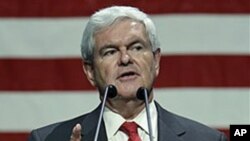
Among them was former House speaker Newt Gingrich. Gingrich is exploring a presidential run next year, and chose to talk about his faith at the Iowa event.
"So, what are the truths? That we are endowed by our creator with certain inalienable rights. Now why does that matter? Because it means the power comes from God to each one of you personally."
Religion also was on the mind of former Minnesota Governor Tim Pawlenty, who quoted heavily from the Bible during his remarks. "The Constitution was designed to protect people of faith from government, not to protect government from people of faith."
Social conservatives are a critical group within the Republican Party, unified by a commitment to family values, and opposition to abortion and gay marriage. Republican presidential contenders often go to great lengths to appeal to social conservatives as a first step toward winning the party’s presidential nomination.
Other key groups within the Republican Party include economic conservatives and so-called Tea Party activists, who advocate cutting the size of government.
So far, none of the major potential Republican candidates have officially declared that they are in the 2012 race, but that is expected to change in the weeks ahead.
Republican pollster and political strategist Frank Luntz said Republican voters are looking for a candidate who embodies conservative principles and is willing to follow through on his or her promises.
Luntz spoke to the CSPAN public affairs network. "What they are looking for from these candidates is someone who says what they mean and means what they say. That phrase, 'say what you mean and mean what you say,' is the most important for any presidential candidate."
Some of the biggest Republican names who may join the 2012 presidential field did not attend the event in Iowa. Among them were former Massachusetts Governor Mitt Romney, former Arkansas Governor Mike Huckabee and former Alaska Governor Sarah Palin. Those three and Newt Gingrich generally are near the top of public opinion polls asking Republicans whom they prefer for 2012.
One wild card in the Republican field could be New York real estate mogul Donald Trump, who has said he will decide on a presidential run by June.
Fordham University political scientist Costas Panagopolous says political newcomers like Trump often face steep challenges when they get involved in presidential politics. "Outsider candidates with very little political experience face an uphill battle running for president under any circumstances, and I think that will be a challenge for anyone like a Donald Trump."
The Republican race has started slowly compared with the 2008 presidential campaign. At this point four years ago, most major contenders from both parties had already declared their candidacies and were out campaigning.
Analyst Rhodes Cook said Republicans historically have had a front-runner, or favorite, at the beginning of the election cycle who usually clinches the party's nomination, such as John McCain in 2008, George W. Bush in 2000 and Bob Dole in 1996.
"I mean, you had these people that were positioned as front-runners at the beginning of the Republican race and who kind of defined the Republican race. This time you don’t have that," said Cook.
In the next several weeks, potential Republican candidates will be out talking to voters and giving speeches in some of the early contest states, and, just as importantly, testing their ability to raise the huge amounts of money necessary to finance a presidential bid next year.
Republican Presidential Hopefuls Woo Social Conservatives
- By Jim Malone