



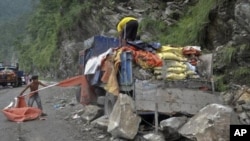
In India’s northeastern Sikkim state, the death toll from Sunday’s strong earthquake has risen to 80 as rescue operations in the remote mountainous continue to pose serious challenges.
At daybreak Tuesday in Sikkim, there was some good news for the Himalayan mountain region jolted by the 6.9 magnitude earthquake two days ago, as national help arrived.
Air force helicopters flew rescue and medical teams to one of the worst affected districts, Mangan. Soldiers used earth movers to open some mountain passes blocked by landslides. Monsoon rains, which had been hampering rescue operations, stopped briefly.
But the scale of the devastation is still not clear.
Remote villages closest to the epicenter of the quake had not been accessed by Tuesday afternoon and hundreds of rescue workers sent from the capital New Delhi are still waiting to reach these areas.
The region is ringed by high mountain peaks and many of the roads have been blocked by fallen trees, boulders and other debris.
Home Secretary R.K. Singh says the death toll could rise, as rescue teams gain access to remote villages. He says helicopters are being used to survey the damage.
“Aerial surveillance has started with one chopper this morning," said Singh. "Food packets are being air-dropped in the northern areas. The state government has informed that they have opened relief camps in each district.”
The quake has put the spotlight on the need to improve disaster preparedness in the remote state.
A rescue management specialist in New Delhi, Angeli Quatra, says rescue and relief have been delayed because local authorities were unprepared to cope with a natural disaster of this scale.
“There should be facilities in the local areas so that immediate relief can be provided," Quatra said. "There should be air ambulances within the state. All these states they need to have local helicopters, because at this time the scenario is that that is the only viable mode of providing relief.”
Quatra points out that nearly two days after the quake hit, there is still no accurate assessment of the number of casualties or those injured.
Most of the deaths caused by Sunday’s earthquake have occurred in Sikkim, which bore the brunt of the disaster. But casualties have also been reported in the neighboring Indian states of Bihar and West Bengal, as well as in Nepal and Tibet.