Researchers Develop Injectable Gel to Repair Damaged Hearts
People who suffer heart attacks are at increased risk of having a second and potentially fatal occurrence because of the damage the heart attack does to cardiac muscle tissue. Now scientists at the University of California San Diego have developed a new biomaterial - an injectable hydrogel - that can repair the damage from heart attacks, and help promote the growth of new heart tissue.
Millions of people around the world suffer heart attacks every year and survive. These traumatic events occur when blood supply to the heart muscles is somehow blocked, robbing them of oxygen and causing them to die. They raise the possibility of subsequent heart attacks, as well as heart failure, and a higher likelihood of death within five years.
The problem, say experts, is the development of scar tissue in the damaged cardiac muscle. Initially helpful in healing the heart, the tough scar tissue actually weakens the supportive protein scaffold, or matrix, that normally exists in the space between heart muscle cells. This scaffold can support and promote the growth of new cells -- except when it's destroyed by post-heart attack scar tissue.
“So we thought the best thing to deliver to the heart would be what was initially there in the first place," said Karen Christman, who is a biomedical engineer interested in tissue regeneration. "And so we developed this liquid form of this cardiac extracellular matrix that once it goes into the tissue can reassemble into that natural scaffold.”
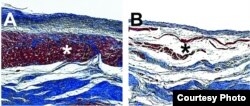
Microscopic images of pig hearts damaged by heart attack show the growth of new heart muscle tissue (shown in red, Figure A) after treatment with an injectable hydrogel compared to a heart left untreated (Figure B, right). Image Credit: Karen Christman, UC San Diego Jacobs School of Engineering.
Christman and colleagues at the University of California San Diego made the hydrogel from a portion of pig heart tissue by first stripping it of all its cells with a detergent, revealing a feathery, translucent web of connective tissue. This matrix was then freeze-dried and milled into a powder.
Next, the material was liquefied and injected directly into the hearts of subject pigs who had experienced heart attacks.
When the cardiac liquid reached body temperature, Christman says, it became a semi-solid gel that formed a new scaffold in damaged areas of the heart. That encouraged new cell growth, she adds, and a more normal, less scar-prone tissue repair.
“When we looked after three months after we had given the treatment, we found a significant increase in cardiac muscle as well as a decrease in scar tissue," she said. "And while we were hoping to see that, that was an exciting new finding since ideally after a heart attack you want to reduce as much scar as possible and get as much muscle as possible.”
Christman says she and her colleagues hope to begin human trials with this minimally-invasive heart repair technique sometime later this year in Europe. The injectable gel would again be produced from pig-heart tissue. Porcine heart valves are frequently used to repair human hearts because they don't cause serious rejection problems in transplant recipients.
The University of California's Karen Christman made her comments in an interview with the journal Science Translational Medicine, which published the article on the cardiac hydrogel.