



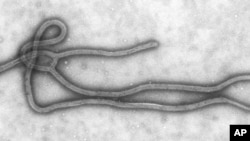
Researchers say they're making progress toward a treatment for the dreaded Ebola virus, which recently caused outbreaks in equatorial Africa. Experiments with monkeys using laboratory-engineered disease-fighting agents called monoclonal antibodies show promise in treating infection with the highly lethal disease.
U.S. government and private industry researchers have developed a drug that contains a cocktail of monoclonal antibodies against Ebola. A monoclonal antibody is a disease-fighting protein engineered to target and disarm a specific virus, bypassing natural antibodies produced by the body’s immune system.
Dubbed MB-003, the anti-Ebola cocktail contains three monoclonal antibodies that attach themselves to three different sites on the surface of the deadly virus. The pathogen, unable to evade the multiple attacks, withers away.
Larry Zeitlin is president of Mapp Biopharmaceutical, which helped develop MB-003. Zeitlin says researchers were originally interested in the monoclonal antibody formulation for bio-defense, should terrorists concoct a biological weapon using Ebola. But Zeitlin says there is an urgent need for a drug to treat the disease during outbreaks.
In experiments, rhesus macaques were infected with lethal doses of Ebola and then given the monoclonal antibodies up to 48 hours after exposure. With the treatment, two-thirds of the monkeys survived, according to Zeitlin.
“And one thing we were excited about is the animals showed very little evidence of disease," said Zeitlin.
Ebola causes a sudden onset of severe headache, vomiting, muscle aches, diarrhea, and bleeding. The disease is fatal in up to 90 percent of cases.
Zeitlin says virologists originally produced the MB-003 proteins in mice, but now use a plant called nicotiana, a relative of tobacco. By infecting it with portions of the Ebola virus, Zeitlin says nicotiana can be tricked into producing the needed monoclonal antibodies.
“Using these plants, we can manufacture pretty significant quantities of antibody very quickly, much quicker than traditional manufacturing systems. So if there were an outbreak of Ebola or some new virus, you could rapidly scale up production of antibodies using this system to address that threat," he said.
Zeitlin says researchers hope to move to human safety trials soon, after conducting more animal studies to confirm the antibodies are safe.
It’s not known precisely where the highly infectious virus comes from, but scientists suspect it originated in non-human primates. Outbreaks typically occur every one to two years in the Democratic Republic of Congo, Gabon, Sudan, the Ivory Coast, Uganda, and the Republic of Congo.
An article on the development of plant-derived monoclonal antibodies to treat Ebola is published in the journal Proceedings of the National Academy of Sciences.
U.S. government and private industry researchers have developed a drug that contains a cocktail of monoclonal antibodies against Ebola. A monoclonal antibody is a disease-fighting protein engineered to target and disarm a specific virus, bypassing natural antibodies produced by the body’s immune system.
Dubbed MB-003, the anti-Ebola cocktail contains three monoclonal antibodies that attach themselves to three different sites on the surface of the deadly virus. The pathogen, unable to evade the multiple attacks, withers away.
Larry Zeitlin is president of Mapp Biopharmaceutical, which helped develop MB-003. Zeitlin says researchers were originally interested in the monoclonal antibody formulation for bio-defense, should terrorists concoct a biological weapon using Ebola. But Zeitlin says there is an urgent need for a drug to treat the disease during outbreaks.
In experiments, rhesus macaques were infected with lethal doses of Ebola and then given the monoclonal antibodies up to 48 hours after exposure. With the treatment, two-thirds of the monkeys survived, according to Zeitlin.
“And one thing we were excited about is the animals showed very little evidence of disease," said Zeitlin.
Ebola causes a sudden onset of severe headache, vomiting, muscle aches, diarrhea, and bleeding. The disease is fatal in up to 90 percent of cases.
Zeitlin says virologists originally produced the MB-003 proteins in mice, but now use a plant called nicotiana, a relative of tobacco. By infecting it with portions of the Ebola virus, Zeitlin says nicotiana can be tricked into producing the needed monoclonal antibodies.
“Using these plants, we can manufacture pretty significant quantities of antibody very quickly, much quicker than traditional manufacturing systems. So if there were an outbreak of Ebola or some new virus, you could rapidly scale up production of antibodies using this system to address that threat," he said.
Zeitlin says researchers hope to move to human safety trials soon, after conducting more animal studies to confirm the antibodies are safe.
It’s not known precisely where the highly infectious virus comes from, but scientists suspect it originated in non-human primates. Outbreaks typically occur every one to two years in the Democratic Republic of Congo, Gabon, Sudan, the Ivory Coast, Uganda, and the Republic of Congo.
An article on the development of plant-derived monoclonal antibodies to treat Ebola is published in the journal Proceedings of the National Academy of Sciences.