



Researchers have stumbled across what may turn out to be a “miracle” treatment for hair loss in humans. The scientists were investigating how stress affects the digestive system when they made the discovery.
The team at the University of California-Los Angeles and U.S. Veterans Administration were working with mice which were genetically engineered to overproduce a stress hormone called corticotrophin-releasing factor or CRF.
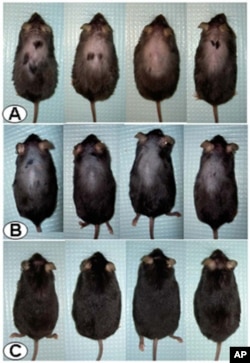
As they aged, these chronically-stressed rodents lost the hair down their backs, much the same way that extreme stress can cause baldness in humans.
Investigators studying irritable bowel syndrome injected the mice for five consecutive days with a chemical compound, or antagonist, called astressin-B, which blocks the effects of CRF, the stress hormone.
Lead researcher Million Mulugeta says they wanted to see if the treatment eased the symptoms of irritable bowel syndrome, a disorder that causes severe pain and cramping.
“And we left these mice back to their home cage and came back three months, and all these mice that received this antagonist had their hair grown back fully,” says Mulugeta.
Four months later, the rodents’ fur showsed no signs of thinning. Mulugeta isn't sure if astressin only reverses stress-related hair loss, or whether it would correct hair loss due to aging or chemotherapy.
Corticotrophin-releasing factor orchestrates the stress response and the cascade of stress hormones that follows. Mulugeta says scientists are now trying to figure out which stress hormones are most closely tied to hair loss so they can develop a treatment that does not disrupt the endocrine system.
While the hair loss treatment has not been tried in humans yet, Mulugeta is optimistic that it will work.
“These hormones and their receptors are present in the skin both in mice and humans, and they are very similar," he says. "So all this gives us hope that the antagonist may work in human(s).”