


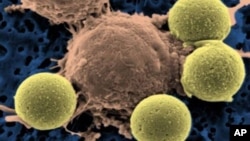
An experimental leukemia therapy appears to have successfully eliminated the lethal blood cancer in some patients. The treatment, which involves a disabled form of the virus that causes AIDS, revs-up immune system cells that then specifically target the malignant cells.
A dozen patients have now undergone the experimental therapy, developed at the University of Pennsylvania. The treatment involves removing millions of T-cells, a type of white blood cell, from each patient and inserting genes that have been programmed to kill B-cells, another type of cell that becomes malignant in leukemia.
The researchers used a non-infectious form of the AIDS virus to transport genetic material into the T-cells, which were then infused back into the cancer patient following chemotherapy. The genetically modified cells attack a protein on the surface of B-cells, killing them, and prompting the production of more modified T-cells.
So far, the experimental treatment has been used successfully on a child with an aggressive form of leukemia and on three adults, all of whom show no signs of disease two years after receiving the therapy.
John Wagner, director of pediatric and bone marrow transplantation at the University of Minnesota, is among those widely praising the new therapy to treat the lethal cancer.
“Basically what this is now is it’s a whole new strategy above and beyond chemotherapy or radiation that uses a whole difficult mechanism to eradicate leukemia that’s particularly resistant,” said Wagner.
Although the treatment was very effective in eliminating disease in four patients, it was only partially effective in two others, who relapsed after therapy. Two patients did not respond at all.
While the new, modified T-cell therapy is an exciting development, Wagner said it only targets a narrow aspect of the blood cancer. The conventional treatment approach is a bone-marrow transplant, which is designed to create a healthy new immune system.
“Bone marrow transplant sort of tackles it all. It’s like throwing the kitchen sink at everything, whereas this is very specific. Clearly, this is very effective in some patients," he said. "But I’m going to be using it in combination to see whether or not I can actually improve the outcome after transplant, above and beyond what we currently see today.”
Details of the experimental leukemia therapy were presented this week at a meeting of the American Society of Hematology in Atlanta. The findings were recently published in the New England Journal of Medicine and Science Translational Medicine.
A dozen patients have now undergone the experimental therapy, developed at the University of Pennsylvania. The treatment involves removing millions of T-cells, a type of white blood cell, from each patient and inserting genes that have been programmed to kill B-cells, another type of cell that becomes malignant in leukemia.
The researchers used a non-infectious form of the AIDS virus to transport genetic material into the T-cells, which were then infused back into the cancer patient following chemotherapy. The genetically modified cells attack a protein on the surface of B-cells, killing them, and prompting the production of more modified T-cells.
So far, the experimental treatment has been used successfully on a child with an aggressive form of leukemia and on three adults, all of whom show no signs of disease two years after receiving the therapy.
John Wagner, director of pediatric and bone marrow transplantation at the University of Minnesota, is among those widely praising the new therapy to treat the lethal cancer.
“Basically what this is now is it’s a whole new strategy above and beyond chemotherapy or radiation that uses a whole difficult mechanism to eradicate leukemia that’s particularly resistant,” said Wagner.
Although the treatment was very effective in eliminating disease in four patients, it was only partially effective in two others, who relapsed after therapy. Two patients did not respond at all.
While the new, modified T-cell therapy is an exciting development, Wagner said it only targets a narrow aspect of the blood cancer. The conventional treatment approach is a bone-marrow transplant, which is designed to create a healthy new immune system.
“Bone marrow transplant sort of tackles it all. It’s like throwing the kitchen sink at everything, whereas this is very specific. Clearly, this is very effective in some patients," he said. "But I’m going to be using it in combination to see whether or not I can actually improve the outcome after transplant, above and beyond what we currently see today.”
Details of the experimental leukemia therapy were presented this week at a meeting of the American Society of Hematology in Atlanta. The findings were recently published in the New England Journal of Medicine and Science Translational Medicine.