



As nations mark World AIDS Day today, the head of a group that provides funding and support to community-based organizations in Africa says the progress in fighting AIDS in hard-hit Sub-Saharan Africa has been "extraordinary" but the challenges that remain are "deep and wide."
Stephen Lewis Foundation executive director Ilana Landsberg-Lewis says grassroots organizations in sub-Saharan Africa have become more sophisticated in devising ways to help those affected.
"The community-based organizations are tremendously effective, whether it's working with women who are, of course, the most infected and affected, but also at the heart of the response to AIDS in communities, or grandmothers looking after orphaned grandchildren, or whether its working with the orphaned kids or whether its working with organizations of people living with HIV and AIDS," said Lewis.
In a VOA interview Friday, Lewis said problems include a lingering stigma about AIDS in the region and inadequate funding for treatment.
"In many communities that don't have access to drugs, or adequate nutrition, or support, the death spiral continues," Lewis added. "There is no question that what one does, what the world does, with over 14 million children orphaned by AIDS is a huge challenge and that continues to be problematic."
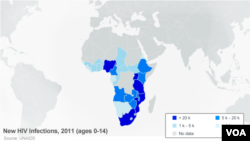
In its World AIDS Day report, the joint United Nations program on HIV/AIDS (UNAIDS) said there has been a 50-percent reduction in the rate of new HIV infections in 25 "low to middle income countries," more than half in Africa.
UNAIDS says of the 34 million people worldwide with HIV in 2011, Sub-Saharan Africa was the most affected region, with nearly one in every 20 adults living with the virus.
The group, however, says AIDS-related deaths in the region have dropped by one-third over the past six years and an increased number of people are receiving antiretroviral treatment.
UNAIDS says some countries which have had the highest HIV prevalence in the world have dramatically cut the rates of new HIV infections since 2001.
It says the rate is down by 73 percent in Malawi, 71 percent in Botswana and 68 percent in Namibia. In its 2012 report, UNAIDS also reports significant reductions in Zambia, Zimbabwe, South Africa and Swaziland.
Stephen Lewis Foundation executive director Ilana Landsberg-Lewis says grassroots organizations in sub-Saharan Africa have become more sophisticated in devising ways to help those affected.
"The community-based organizations are tremendously effective, whether it's working with women who are, of course, the most infected and affected, but also at the heart of the response to AIDS in communities, or grandmothers looking after orphaned grandchildren, or whether its working with the orphaned kids or whether its working with organizations of people living with HIV and AIDS," said Lewis.
In a VOA interview Friday, Lewis said problems include a lingering stigma about AIDS in the region and inadequate funding for treatment.
"In many communities that don't have access to drugs, or adequate nutrition, or support, the death spiral continues," Lewis added. "There is no question that what one does, what the world does, with over 14 million children orphaned by AIDS is a huge challenge and that continues to be problematic."
In its World AIDS Day report, the joint United Nations program on HIV/AIDS (UNAIDS) said there has been a 50-percent reduction in the rate of new HIV infections in 25 "low to middle income countries," more than half in Africa.
UNAIDS says of the 34 million people worldwide with HIV in 2011, Sub-Saharan Africa was the most affected region, with nearly one in every 20 adults living with the virus.
The group, however, says AIDS-related deaths in the region have dropped by one-third over the past six years and an increased number of people are receiving antiretroviral treatment.
UNAIDS says some countries which have had the highest HIV prevalence in the world have dramatically cut the rates of new HIV infections since 2001.
It says the rate is down by 73 percent in Malawi, 71 percent in Botswana and 68 percent in Namibia. In its 2012 report, UNAIDS also reports significant reductions in Zambia, Zimbabwe, South Africa and Swaziland.