Deepening Divides Stop Libyan Families from Returning Home
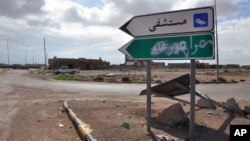
A road sign pointing to the town of Tawergha, a former bastion of support for Moammar Gadhafi, has been painted over with "Misrata," in Arabic, as part of score-settling following Libya's eight-month civil war.
TRIPOLI —
Every day, Ibtisam Mohammed Salem's children ask her when they will go back to their home in the abandoned Libyan town of Tawergha. Although she wants to reassure them, she fears they will have a long wait.
Salem, 32, and her family were among thousands of residents of the town - used as a base by Moammar Gadhafi during the country's 2011 uprising - who fled when victorious rebels charged in.
More than a year on, the people of Tawergha are still stuck in limbo, homeless and, they say, abandoned by a country that has unfairly branded them as supporters of the fallen autocrat.
They say they fear persecution, revenge attacks and arbitrary arrest if they return - the legacy of a war that has sharpened divisions in the oil-producing nation and raised fears of reprisals in other former Gaddafi bastions including Sirte and Bani Walid.
Salem, her husband Ali and their two young children are now camped in a former dormitory of a naval academy in the capital Tripoli. Other bands of Tawergha residents fled east to Benghazi and south to other smaller settlements to shelter in construction sites and empty buildings.
"There is no security for people to return to Tawergha. This is the reality - we are limited, we have no freedom,'' said Salem, sitting in the room Ali jokingly calls "five stars'' because it has a bathroom and balcony that serves as a kitchen.
They say they are being punished for coming from a town that Gadhafi's forces used as a base to bombard rebels positions 50 km (31 miles) away in the coastal city of Misrata during the country's uprising.
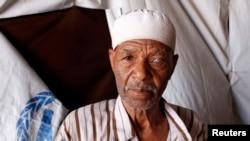
Displaced Libyans from the city of Tawergha live in prefabricated houses for workers at a construction site on the outskirts of Benghazi July 9, 2012.
Tawerghans say they were held hostage by Gadhafi's men and only a few served voluntarily in his forces.
Like many people from Tawergha, their skin is darker than that of their neighbors. That too has counted against them.
Rebels say Gadhafi was backed by "African'' mercenaries from as far afield as Sudan and some are still seeking revenge.
"My family never had anything to do with the Gaddafi regime but we are paying a price for something we are not responsible for ... This is collective punishment,'' said Ali.
Healing old wounds
Rights groups have said Misrata rebels, seeking revenge, looted and destroyed homes in Tawergha and nearby farming villages after Gaddafi's shelling campaign.
Human Rights Watch has said about 1,300 people from Tawergha are detained, missing or dead, and abuses committed against Tawerghans "may amount to crimes against humanity and could be prosecuted by the International Criminal Court''.
The reported violence underlines the challenge Libya's new rulers face reconciling grievances and embracing those who chose not to back the revolt - either out of fear or because they genuinely supported Gaddafi.
With police and courts weak and guns everywhere, Libyans have settled their own scores and clashes have broken out between former rebels and clans that fought alongside Gaddafi or stayed on the sidelines.
The government says it is working to promote reconciliation.
"I believe all will return to normal,'' Social Affairs Minister Kamla Khamis Mazini told Reuters. "Libyan people are merciful and this anger will recede soon. In Misrata, we have elders we can rely on to settle this,'' she added.
But Misrata residents said they were more interested in getting justice for the killings and rapes and other atrocities they suffered during the conflict.
"You cannot speak of reconciliation before justice can be done for the Misrati people ... The wound is still bleeding and unless it heals, it is very difficult to talk to people,'' said Ramadan Awad Benruwin, a member of Misrata's local council.
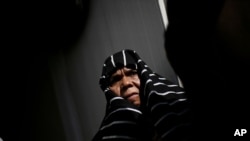
Libyan Tawergha woman is seen in a refugee camp at the outskirts of Benghazi, Libya, March 7, 2012.
While some Tawerghans say they maintain old friendships with Misratans via social media sites, they do so in secret. Many in Misrata say Tawerghans can not return and, for now, officials in Tripoli have proved powerless to insist otherwise.
"Guantanamo is better than this"
Fed up with waiting, some former Tawergha residents say they will return in June to the ghost town, even though state security forces are too weak to protect them.
Among the rubbish-strewn camps where the Tawerghans now live, often in fear of eviction, the discontent is simmering.
At Tripoli's Fellah building site, about 1,060 stay in workers' dormitories. Only a few earn money doing odd jobs - most worked in Misrata before.
Inside, families sleep on beds or floors laden with suitcases, mattresses and blankets.
"Guantanamo is better than this,'' said Omar Mohammed, who lives with his family of six in one room. "Our future is dark but I can't say anything or they will call us Gaddafi supporters.''
Tawergha, once known for its dates, is eerily quiet. Houses and apartment blocks are riddled with holes.
Empty bullet shells are scattered on the dusty ground among sandals, broken plates, milk cartons and clothes. The wall of a mosque is sprayed with graffiti - "Misrata is strong''.
"I haven't seen my home since August 2011. I know it is destroyed,'' said Moad, a 23-year-old man in Fellah."But I want to return and rebuild it. I want to go back to my land.''
Reuters is a news agency founded in 1851 and owned by the Thomson Reuters Corporation based in Toronto, Canada. One of the world's largest wire services, it provides financial news as well as international coverage in over 16 languages to more than 1000 newspapers and 750 broadcasters around the globe.