


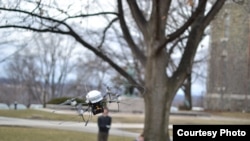
Researchers at Cornell University have developed a flying robot they say is “as smart as a bird” because it can maneuver to avoid obstacles. They say it eventually could be used in search-and-rescue operations because of its ability to maneuver through forests, tunnels or inside damaged buildings.
“Most previous robots assumed perfectly known location of obstacles,” said Ashutosh Saxena, assistant professor of computer science who led the team developing the robot. “Some of the recent ones used 3-D cameras to navigate indoors. However, these techniques did not apply to outdoor environments with unstructured obstacles like trees, branches and poles. In that sense, this is a first one that can learn to avoid such obstacles.”
Miniature Aerial Vehicles are commonly used today for a variety of tasks, but they are mostly guided by humans using Global Positioning System (GPS) technology. Saxena’s team wanted to program the robot to recognize obstacles and avoid them on its own with limited human assistance.
Saxena explained that requirement by noting that there is no guarantee there would be GPS coverage in a fallen building, and that human controllers can’t always react quickly enough in tight areas.
“The operator is looking at a tiny screen and trying to control the machine,” he said. “They don’t have the physical sense of where things are.”
Saxena, along with his team of Ian Lenz and Mevlana Gemici, tested the programming using a commercially available quadrotor flying machine, which is about the size of a small table and has four helicopter rotors. The first step, Saxena said, was to program the quadrotor to navigate through hallways and stairwells.
The trick was to teach the robot to avoid obstacles in less predictable environments such as outdoors. Saxena and his team were able to program the robot to turn a flat image into an approximate 3-D model of the environment to estimate the size and distance of an object and then take evasive action at the appropriate time.
Still, hurdles remain before the robot could be used in a real-world scenario. It still needs to be able to adapt to environmental variations like wind as well as be able to detect moving objects like birds.
“It would not be zipping through like in Star Wars,” he cautioned.
The project is supported by a grant from the Defense Advanced Research Projects Agency (DARPA).
Here's a video of the aerial vehicle in action:
“Most previous robots assumed perfectly known location of obstacles,” said Ashutosh Saxena, assistant professor of computer science who led the team developing the robot. “Some of the recent ones used 3-D cameras to navigate indoors. However, these techniques did not apply to outdoor environments with unstructured obstacles like trees, branches and poles. In that sense, this is a first one that can learn to avoid such obstacles.”
Miniature Aerial Vehicles are commonly used today for a variety of tasks, but they are mostly guided by humans using Global Positioning System (GPS) technology. Saxena’s team wanted to program the robot to recognize obstacles and avoid them on its own with limited human assistance.
Saxena explained that requirement by noting that there is no guarantee there would be GPS coverage in a fallen building, and that human controllers can’t always react quickly enough in tight areas.
“The operator is looking at a tiny screen and trying to control the machine,” he said. “They don’t have the physical sense of where things are.”
Saxena, along with his team of Ian Lenz and Mevlana Gemici, tested the programming using a commercially available quadrotor flying machine, which is about the size of a small table and has four helicopter rotors. The first step, Saxena said, was to program the quadrotor to navigate through hallways and stairwells.
The trick was to teach the robot to avoid obstacles in less predictable environments such as outdoors. Saxena and his team were able to program the robot to turn a flat image into an approximate 3-D model of the environment to estimate the size and distance of an object and then take evasive action at the appropriate time.
Still, hurdles remain before the robot could be used in a real-world scenario. It still needs to be able to adapt to environmental variations like wind as well as be able to detect moving objects like birds.
“It would not be zipping through like in Star Wars,” he cautioned.
The project is supported by a grant from the Defense Advanced Research Projects Agency (DARPA).
Here's a video of the aerial vehicle in action: