



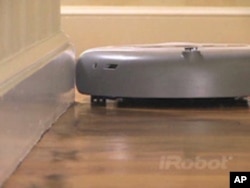
These days, robots are more common than you might think. Consider the Roomba, a programmable robotic vacuum which cleans floors on its own.
"We wanted to make something simple that people could use every day," says Helen Greiner, co-founder of iRobot, the company that makes the smart vacuum. "And that's what inspired us to build the Roomba."
IRobot makes everything from the Roomba and remote-controlled bomb-disposal units, to robots that someday might become a part of us.
"You can have robotics incorporated into your body, to give back that arm or leg that you've lost, either in service or through some accident or disease," says Greiner.
Robots for everyday
New robot technology was on display recently in Denver, Colorado, at the annual convention of the Association for Unmanned Vehicles International.
Although robots have been developed mainly for military applications, civilian uses for the technology are growing, according to Michael Toscano, president of the Association for Unmanned Vehicles International.
"Whether it be firefighting, whether it be first responders or disaster response, unmanned systems allow that human being to be able do their mission with an extension of their hands, their eyes and their ears."
Remote-controlled land rovers can detonate bombs or buried land mines. Edison Hudson of iRobot says some robots swim and can monitor ocean pollution.
"We can put them in the ocean and they'll swim for eight or nine months, collecting data," says Hudson.
Robotic 'man'
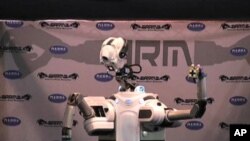
At the convention, the U.S. Government's Defense Advanced Research Projects Agency, better known as DARPA, displayed a state-of-the-art robotic "man."
"DARPA has a history of inventing things like the Arpanet - which was the father of the Internet in the 1960s - Saturn 5 rockets, Stealth aircraft," says Robert Mandelbaum, DARPA's project manager.
DARPA's "robotic man" is the Autonomous Robotic Manipulation program, or ARM. Instead of depending on remote-control, ARM can actually look at some blocks, find one with a special pattern, and move it to a new location. Mandelbaum says more challenging tasks lie ahead.
"Pick up a gym bag, unzip it, reach inside, feel around without visual feedback, and find an object that's inside the gym bag."
Some day, a DARPA robot might find a hidden bomb or help a disabled person select a shirt and button it.
To advance the technology, DARPA plans to let members of the pubic write software for ARM, then sign onto the Internet and watch a model of ARM perform the task.
It's one of the ways, experts say, that robots will help humankind to extend its reach.