


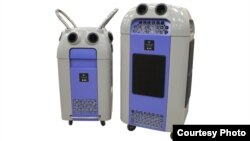
It's a growing problem for hospitals around the world: strains of deadly, drug-resistant bacteria contaminating operating and recovery rooms. To combat this serious threat to patient health, two dozen U.S. hospitals are now using robotic, hydrogen-peroxide vaporizers to sanitize rooms where infected patients have stayed. A new study finds that use of the vaporizers' germ-killing mist has significantly lowered the number of hospital-borne infections.
Hospitals can be a haven for many types of dangerous, antibiotic-resistant bacteria, including methicillin-resistant Staphylococcus aureus, or MRSA. The microbes can survive on hard surfaces long after an infected patient has been discharged.
Traditional hand-cleaning and mopping of individual rooms between patients, using simple anti-bacterial cleansers, often leave some microbes behind, according to Trish Perl, a professor of medicine at The Johns Hopkins University in Baltimore, Maryland.
“There are very complicated surfaces with equipment and little nooks and crannies that are hard to clean. They (the cleaning staff) are given a short period of time to clean rooms and they simply can’t physically get everything clean before the room turns over,” Perl said.
So, researchers led by Perl conducted the first comprehensive study to see if they could reduce the risk of transmitting antibiotic-resistant organisms. They compared traditional disinfecting methods to standard cleaning, adding the disinfecting robots.
Perl says the mobile vaporizers resemble R2D2 -- the little dome-topped robot in the Star War movies -- with a spray nozzle on top.
“And it spins around the room. So it turns its head 360 degrees,” Perl said.
The nozzle emits a fine mist of hydrogen peroxide, a powerful antibacterial bleaching agent. Because the bleach can be toxic to humans if ingested or inhaled, a second vaporizing robot is wheeled into a room to spray a solution that breaks down the hydrogen peroxide into harmless water and oxygen molecules, according to Perl.
"It doesn't destroy hospital surfaces, including equipment surfaces - things like computers and all this technological stuff you find in buildings," Perl said.
Hopkins researchers closely monitored some 6,300 patients who stayed in 180 private rooms over a 2 1/2 year period. Half of the rooms were disinfected only by hand, while the other half were also treated with the robotic vaporizers.
In the end, 21 percent of the rooms harbored drug-resistant organisms, most of them not sanitized by the robots, while the hydrogen peroxide-vaporizing machines reduced by 64 percent the number of patients who later contracted a hospital-borne infection. They also lowered the risk of infection with drug-resistant enterococci by 80 percent.
The twin robots are expensive. Together, they cost about $40,000. Perl says she hopes that Bioquell, the U.S. manufacturer, can bring down that price eventually so the devices will be more affordable to hospitals in developing countries.
The sanitizing machines were first used in several Singapore hospitals in 2002 during the outbreak of severe acute respiratory syndrome, or SARS.
An article on the effectiveness of vapor-dispensing robots in controlling hospital infections is published in the journal Clinical Infectious Diseases.
Hospitals can be a haven for many types of dangerous, antibiotic-resistant bacteria, including methicillin-resistant Staphylococcus aureus, or MRSA. The microbes can survive on hard surfaces long after an infected patient has been discharged.
Traditional hand-cleaning and mopping of individual rooms between patients, using simple anti-bacterial cleansers, often leave some microbes behind, according to Trish Perl, a professor of medicine at The Johns Hopkins University in Baltimore, Maryland.
“There are very complicated surfaces with equipment and little nooks and crannies that are hard to clean. They (the cleaning staff) are given a short period of time to clean rooms and they simply can’t physically get everything clean before the room turns over,” Perl said.
So, researchers led by Perl conducted the first comprehensive study to see if they could reduce the risk of transmitting antibiotic-resistant organisms. They compared traditional disinfecting methods to standard cleaning, adding the disinfecting robots.
Perl says the mobile vaporizers resemble R2D2 -- the little dome-topped robot in the Star War movies -- with a spray nozzle on top.
“And it spins around the room. So it turns its head 360 degrees,” Perl said.
The nozzle emits a fine mist of hydrogen peroxide, a powerful antibacterial bleaching agent. Because the bleach can be toxic to humans if ingested or inhaled, a second vaporizing robot is wheeled into a room to spray a solution that breaks down the hydrogen peroxide into harmless water and oxygen molecules, according to Perl.
"It doesn't destroy hospital surfaces, including equipment surfaces - things like computers and all this technological stuff you find in buildings," Perl said.
Hopkins researchers closely monitored some 6,300 patients who stayed in 180 private rooms over a 2 1/2 year period. Half of the rooms were disinfected only by hand, while the other half were also treated with the robotic vaporizers.
In the end, 21 percent of the rooms harbored drug-resistant organisms, most of them not sanitized by the robots, while the hydrogen peroxide-vaporizing machines reduced by 64 percent the number of patients who later contracted a hospital-borne infection. They also lowered the risk of infection with drug-resistant enterococci by 80 percent.
The twin robots are expensive. Together, they cost about $40,000. Perl says she hopes that Bioquell, the U.S. manufacturer, can bring down that price eventually so the devices will be more affordable to hospitals in developing countries.
The sanitizing machines were first used in several Singapore hospitals in 2002 during the outbreak of severe acute respiratory syndrome, or SARS.
An article on the effectiveness of vapor-dispensing robots in controlling hospital infections is published in the journal Clinical Infectious Diseases.