


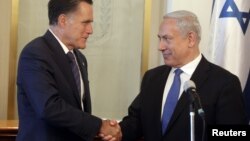
During a visit Sunday to Israel, the man expected to be the Republican Party nominee for U.S. president, Mitt Romney, said it is “unacceptable” for Iran to acquire a nuclear weapon.
It was during an appearance with Israeli President Shimon Peres that Romney made his statement on Iran.
"We are very concerned about the development of nuclear capacity on the part of Iran and feel it is unacceptable for Iran to become a nuclear armed nation. The threat it would pose to Israel, to the region and to the world is incomparable and unacceptable."
The former Massachusetts governor is in the middle of a trip to Britain, Israel and Poland that analysts say is intended in part to demonstrate some expertise in foreign policy. In his public comments in Israel, he did not go as far as his foreign policy adviser Dan Senor, who told reporters that, if elected president, Romney would not try to stop Israel from attacking Iran's nuclear sites.
The candidate declined to repeat that position during an appearance on CBS television, saying he did not want to diverge from official U.S. policy while on a foreign trip. The Obama administration has discouraged any military action against Iran while talks are under way, and Romney appeared to endorse that approach.
Iran says its nuclear program is for peaceful research, but foreign experts believe its uranium-enrichment program is designed to bring it to the brink of a nuclear weapons capability, and some believe it is only a matter of months away from building a nuclear bomb if its leaders want to.
After meeting with Romney earlier in the visit, Israeli Prime Minister Benjamin Netanyahu also appeared to indicate he is focused on sanctions and the threat of military action to try to motivate Iran to change its nuclear policy. But Netanyahu added he is not very hopeful that the approach will work.
"We have to be honest and say that all the sanctions and diplomacy, so far, have not set back the Iranian program by one iota. And that is why I believe that we need a strong and credible military threat coupled with the sanctions to have a chance to change that situation."
Talks between Iran and a U.N.-designated team of countries have been demoted to the “expert” level because senior negotiators were not able to make any progress in two recent meetings. But the talks have not officially broken down.
Romney is to be formally nominated by the Republican Party at the end of next month, and he is expected to run a close race with the Democratic Party's candidate, President Barack Obama, in the November election. The votes of Israel supporters will be important to both candidates, but support for Israel is among many foreign policy issues on which there is little or no difference between members of the two parties.
With the Israel stop behind him, Romney travels to Poland for meetings Monday with leaders of one of the key U.S. allies in Europe. He will also visit memorial sites related to World War Two and the country's Solidarity Movement, which spearheaded the successful revolution against communist rule.
It was during an appearance with Israeli President Shimon Peres that Romney made his statement on Iran.
"We are very concerned about the development of nuclear capacity on the part of Iran and feel it is unacceptable for Iran to become a nuclear armed nation. The threat it would pose to Israel, to the region and to the world is incomparable and unacceptable."
The former Massachusetts governor is in the middle of a trip to Britain, Israel and Poland that analysts say is intended in part to demonstrate some expertise in foreign policy. In his public comments in Israel, he did not go as far as his foreign policy adviser Dan Senor, who told reporters that, if elected president, Romney would not try to stop Israel from attacking Iran's nuclear sites.
The candidate declined to repeat that position during an appearance on CBS television, saying he did not want to diverge from official U.S. policy while on a foreign trip. The Obama administration has discouraged any military action against Iran while talks are under way, and Romney appeared to endorse that approach.
Iran says its nuclear program is for peaceful research, but foreign experts believe its uranium-enrichment program is designed to bring it to the brink of a nuclear weapons capability, and some believe it is only a matter of months away from building a nuclear bomb if its leaders want to.
After meeting with Romney earlier in the visit, Israeli Prime Minister Benjamin Netanyahu also appeared to indicate he is focused on sanctions and the threat of military action to try to motivate Iran to change its nuclear policy. But Netanyahu added he is not very hopeful that the approach will work.
"We have to be honest and say that all the sanctions and diplomacy, so far, have not set back the Iranian program by one iota. And that is why I believe that we need a strong and credible military threat coupled with the sanctions to have a chance to change that situation."
Talks between Iran and a U.N.-designated team of countries have been demoted to the “expert” level because senior negotiators were not able to make any progress in two recent meetings. But the talks have not officially broken down.
Romney is to be formally nominated by the Republican Party at the end of next month, and he is expected to run a close race with the Democratic Party's candidate, President Barack Obama, in the November election. The votes of Israel supporters will be important to both candidates, but support for Israel is among many foreign policy issues on which there is little or no difference between members of the two parties.
With the Israel stop behind him, Romney travels to Poland for meetings Monday with leaders of one of the key U.S. allies in Europe. He will also visit memorial sites related to World War Two and the country's Solidarity Movement, which spearheaded the successful revolution against communist rule.