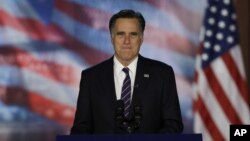
Defeated U.S. presidential contender Mitt Romney is telling his campaign donors that he lost last week's national election because President Barack Obama showered "financial gifts" from the government on segments of the American electorate who then voted for him.
In a post-election call to the donors Wednesday, the Republican challenger said the Democratic incumbent had handed key voting blocs - African Americans, Hispanics and young people - significant aid. He cited passage of Obama's national health care reform, which allowed young adults to use their parents' health insurance, and the president's ending deportation of most young immigrants brought to the U.S. illegally by their parents.
"What the president, president's campaign did was focus on certain members of his base coalition, give them extraordinary financial gifts from the government. And then work very aggressively to turn them out to vote," said Romney.
After conceding to Obama the night of the election, the one-time venture capitalist has not commented publicly on the outcome. But his comments to the donors this week echoed his secretly-taped complaint several months ago to another group of contributors that nearly half of the American populace has become dependent on government assistance of one sort or another. In that tape, he said such people were not likely to vote for him.
Surveys of voters leaving polling places on November 6 showed that blacks, Hispanics, Asians and young people voted overwhelmingly for Obama. Romney said the president had adopted a time-tested strategy.
"I mean it's a proven political strategy, which is give a bunch of money from the government to a, to a group. And guess what? They'll vote for you," he said.
Numerous U.S. political analysts have cited the heavy support among racial minorities for Obama as one key to his victory. But they also have cited other reasons.
Some say Romney was a weak challenger that Republicans were slow to embrace. Pollster Andrew Kohut of the respected Pew Research Center noted that surveys of people leaving their polling places showed that only 47 percent viewed Romney favorably, with campaign-long doubts that the wealthy businessman had much empathy with them.
In a post-election call to the donors Wednesday, the Republican challenger said the Democratic incumbent had handed key voting blocs - African Americans, Hispanics and young people - significant aid. He cited passage of Obama's national health care reform, which allowed young adults to use their parents' health insurance, and the president's ending deportation of most young immigrants brought to the U.S. illegally by their parents.
"What the president, president's campaign did was focus on certain members of his base coalition, give them extraordinary financial gifts from the government. And then work very aggressively to turn them out to vote," said Romney.
After conceding to Obama the night of the election, the one-time venture capitalist has not commented publicly on the outcome. But his comments to the donors this week echoed his secretly-taped complaint several months ago to another group of contributors that nearly half of the American populace has become dependent on government assistance of one sort or another. In that tape, he said such people were not likely to vote for him.
Surveys of voters leaving polling places on November 6 showed that blacks, Hispanics, Asians and young people voted overwhelmingly for Obama. Romney said the president had adopted a time-tested strategy.
"I mean it's a proven political strategy, which is give a bunch of money from the government to a, to a group. And guess what? They'll vote for you," he said.
Numerous U.S. political analysts have cited the heavy support among racial minorities for Obama as one key to his victory. But they also have cited other reasons.
Some say Romney was a weak challenger that Republicans were slow to embrace. Pollster Andrew Kohut of the respected Pew Research Center noted that surveys of people leaving their polling places showed that only 47 percent viewed Romney favorably, with campaign-long doubts that the wealthy businessman had much empathy with them.