



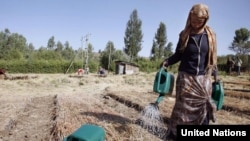
October 15th is International Day of Rural Women. The United Nations says rural women play a critical role in development, food security and eradicating poverty.
Four U.N. agencies recently launched a five year initiative to speed economic empowerment and gender equality of rural women. Initially, the program will be implemented in seven countries: Ethiopia, Liberia, Niger, Rwanda, Guatemala, Nepal and Kyrgyzstan.
“When women are empowered, things change, not only for her, but also for the other members of the household and then also for the economy,” said Clare Bishop Sambrook, senior advisor on gender for IFAD, the International Fund for Agricultural Development.
Sambrook described a typical day for a rural woman in East Africa.
“Basically, she’d be getting up in the dark and going to bed in the dark. And she’d start off by cleaning the compound; doing a little bit of cooking of a snack that she and her husband would take to the fields. And then she and her husband would take the agricultural tools, perhaps a hoe, perhaps some draft animals and a plough off to the fields, which might be half an hour away, an hour away. Work there for two or three hours, but then on the way back she’s collecting bits of vegetation and things she could use for adding to the basic diet for lunch,” she said.
But that’s only half the day.
“When she gets home then she’d be bathing the children and preparing the food. And then in the afternoon perhaps spending two or three hours going off collecting the water and coming back and collecting firewood on the way. So she’d be carrying the water on her head and the firewood on her back. And perhaps accompanied by one or two little children. Then she gets home and then does more food preparation, which might be by hand, using a local means of crushing the maize. And then cooking the food and then perhaps caring for other household members. And then, eventually, retiring to bed at about nine o’clock,” she said.
Besides IFAD, the rural women’s empowerment initiative is sponsored by the Food and Agriculture Organization, the World Food Program and UN Women.
The agencies say rural women make up 43 percent of the agricultural workforce worldwide. In some countries they may be more than 70 percent of the agricultural laborers.
Sambrook says the U.N. initiative is designed to help households to “work together as a unit.”
“Rather than the men and the women having different agendas – the women working a lot, but not having much say in how the money’s spent -- we’re now getting households to do household planning and household visioning, where together they sit down to look to what they might want to do in the future,” she said.
That can include such things as getting a new roof, a better home, a mobile phone or a solar energy panel.
The U.N. agencies also help to “reduce the daily burden of living,” such as creating a community water system or providing fuel efficient stoves that need much less firewood.
“Now it’s not just within the farming community that they look for new lives, but also in off-farm activities. So we also work with developing tailoring or fisheries or complementary rurally based activities,” she said.
The IFAD gender advisor said in India, for example, rural women opened very small businesses to sell tea, cooking oil or soap. The women were able to save some money and in one community formed a federation.
“Just to give you an idea of the scale, one group was describing to us that they had a meeting with the local bank, who wanted to provide improved services to rural women. And the bank manager had said I’ll meet with a group of you. And much to his amazement over a thousand women from this one apex organization turned up to talk to him, both to hear what he was going to talk about, but also to demand the types of services that meet their needs,” she said.
The first International Day of Rural Women was observed on October 15th, 2008.
Four U.N. agencies recently launched a five year initiative to speed economic empowerment and gender equality of rural women. Initially, the program will be implemented in seven countries: Ethiopia, Liberia, Niger, Rwanda, Guatemala, Nepal and Kyrgyzstan.
“When women are empowered, things change, not only for her, but also for the other members of the household and then also for the economy,” said Clare Bishop Sambrook, senior advisor on gender for IFAD, the International Fund for Agricultural Development.
Sambrook described a typical day for a rural woman in East Africa.
“Basically, she’d be getting up in the dark and going to bed in the dark. And she’d start off by cleaning the compound; doing a little bit of cooking of a snack that she and her husband would take to the fields. And then she and her husband would take the agricultural tools, perhaps a hoe, perhaps some draft animals and a plough off to the fields, which might be half an hour away, an hour away. Work there for two or three hours, but then on the way back she’s collecting bits of vegetation and things she could use for adding to the basic diet for lunch,” she said.
But that’s only half the day.
“When she gets home then she’d be bathing the children and preparing the food. And then in the afternoon perhaps spending two or three hours going off collecting the water and coming back and collecting firewood on the way. So she’d be carrying the water on her head and the firewood on her back. And perhaps accompanied by one or two little children. Then she gets home and then does more food preparation, which might be by hand, using a local means of crushing the maize. And then cooking the food and then perhaps caring for other household members. And then, eventually, retiring to bed at about nine o’clock,” she said.
Besides IFAD, the rural women’s empowerment initiative is sponsored by the Food and Agriculture Organization, the World Food Program and UN Women.
The agencies say rural women make up 43 percent of the agricultural workforce worldwide. In some countries they may be more than 70 percent of the agricultural laborers.
Sambrook says the U.N. initiative is designed to help households to “work together as a unit.”
“Rather than the men and the women having different agendas – the women working a lot, but not having much say in how the money’s spent -- we’re now getting households to do household planning and household visioning, where together they sit down to look to what they might want to do in the future,” she said.
That can include such things as getting a new roof, a better home, a mobile phone or a solar energy panel.
The U.N. agencies also help to “reduce the daily burden of living,” such as creating a community water system or providing fuel efficient stoves that need much less firewood.
“Now it’s not just within the farming community that they look for new lives, but also in off-farm activities. So we also work with developing tailoring or fisheries or complementary rurally based activities,” she said.
The IFAD gender advisor said in India, for example, rural women opened very small businesses to sell tea, cooking oil or soap. The women were able to save some money and in one community formed a federation.
“Just to give you an idea of the scale, one group was describing to us that they had a meeting with the local bank, who wanted to provide improved services to rural women. And the bank manager had said I’ll meet with a group of you. And much to his amazement over a thousand women from this one apex organization turned up to talk to him, both to hear what he was going to talk about, but also to demand the types of services that meet their needs,” she said.
The first International Day of Rural Women was observed on October 15th, 2008.