



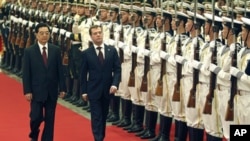
Russia and China are swapping roles in their bilateral trade. Russia once sold arms, cars and machinery to China, but is now selling raw materials and importing Chinese manufactured goods.
Russia's president, Dimitry Medvedev, came back from China last week with a briefcase filled with energy contracts. But he did not take home what he really wanted: Chinese commitments to invest in modernizing Russian factories.
Russia's president reported on his fifth meeting this year with the Chinese President Hu Jintao, saying Chinese officials promised to consider investing in a new technology park under construction outside Moscow.
To some, Russia and China make a perfect couple - a marriage between the world's-largest energy producer and the world's-largest energy consumer.
Under deals signed in recent days, Russia will soon be supplying 10 percent of China's imported oil and coal. In other deals, China is investing billions of dollars in Russian iron mines, aluminum smelters, timber companies, and corporate farms.
During the past decade, trade between Russia and China increased 12-fold, allowing China to dethrone Germany as Russia's top trading partner. Since 2007, the fastest growing region in Russia has been the Far East, the section of Siberia that borders China.
But Russian sales of cars and weapons to China have fallen dramatically. Moscow-based economic analyst Chris Weafer says Russians do not like to look in the mirror and see themselves as raw materials supplier to China, the factory to the world.
No Chinese commitments beyond energy
"President Medvedev and the Russian side, they wanted to talk more about China's involvement in the modernization and investment into Russian industry, beyond energy. But when they got there, all the Chinese wanted to talk about was how to get more energy,'' Weafer said.
In the only manufacturing deal announced, a Chinese company agreed to help build trucks in the Urals.
If China is not interested in helping Russians build better products, it appears to have unlimited appetite for importing Russian energy - oil, gas, and electricity.
At present, the bulk of China's imported oil and gas comes by tankers passing through a geographic chokepoint: the Straits of Malacca. To cut this strategic weakness, China wants to develop energy imports by land.
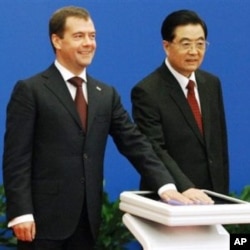
Last week, the presidents of Russia and China symbolically inaugurated the first oil pipeline from Russia. Beginning in January, Siberian oil is to move 1,000 kilometers through this pipeline to Northeast China.
The Chinese want this to be followed by a gas pipeline. Both sides promise a deal will be cut by next summer, but negotiations about price have continued for 10 years.
Australian analyst Bobo Lo studied this deadlock for his book: "Axis of Convenience: Moscow, Beijing and the New Geopolitics."
"People say, 'Oh, it is just pricing.' But pricing is absolutely critical,'' Lo said. "Because until they agree on pricing, they will not even build the pipelines."
Cutting Russia's bargaining power
While Russia holds out for the best price, gas demand in Europe is weak, shale gas makes North America self-sufficient in gas, and shiploads of liquefied natural gas cruise the oceans looking for buyers. Further cutting Russia's bargaining power, new gas and oil pipelines stretch thousands of kilometers from Central Asia to China.
Chris Weafer again.
"China has now been able to put the gun to the head to the Russians to some extent and say, 'You have got to do this now, on terms that suit us,'' Weafer said. "Otherwise we are not going to do it all, because we have other options.' China can get more energy supplies from Central Asia."
A fact highlighted while Mr. Medvedev visited Beijing, Turkmenistan's president inaugurated a compression station what will boost that nation's gas exporting capacity to China to 40 billion cubic meters a year - more than the entire volume Russia agreed long ago to sell to China.