News / Europe

    Russia's Military Preparations Raise Concerns in Europe, Ukraine

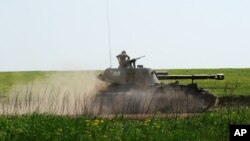
    An armored Russian vehicle rides during a training exercise at the Kuzminsky military training ground outside the village of Chkalovo near the Russian-Ukrainian border, in the Rostov region, Russia, May 25, 2015.
    An armored Russian vehicle rides during a training exercise at the Kuzminsky military training ground outside the village of Chkalovo near the Russian-Ukrainian border, in the Rostov region, Russia, May 25, 2015.
    Daniel Schearf

    Russia this week held surprise, massive military exercises as members of NATO, the western military alliance, took part in its own drills. Military analysts say the military muscle-flexing increases the chances for incidents that could spark a wider conflict. 

    The drills come as the Reuters news agency reports a Russian military build-up on the border with Ukraine and President Vladimir Putin signs a law making the loss of Russian troops in special operations a state secret.  

    Russia's military this week held four days of unannounced, large-scale drills involving hundreds of fighter jets, anti-aircraft missiles, and 12,000 troops.
    Russia's Defense Ministry called the exercises a “surprise combat readiness inspection” for its air forces.  It also held military drills in the central, south, and west of the country as part of preparations for a larger exercise later this year.

    Russia's snap drills came as members of NATO, the North Atlantic Treaty Organization, began two weeks of drills in the Arctic with 100 aircraft and 4,000 troops.

    Pavel Felgenhauer, a defense analyst and columnist with Novaya Gazeta in Moscow, says the military muscle-flexing will further cause already tense relations between Russia and the West to deteriorate.

    “Well, it's not just simply messages - actually preparation for a possible confrontation.  And, also it is a message that we're there and ready to take on any and [every] possible enemy," said Felgenhauer.

    While the NATO members' exercises were announced months in advance, the Western military alliance has expressed concern about the string of sudden Russian military drills.

    Russia's military has been posturing and probing since tensions broke out over the Kremlin's annexation of Ukraine's Crimean peninsula and support for rebels in Ukraine's east.

    NATO countries have recorded increased scrambling of fighter jets to intercept Russian ones coming too close to their air space.

    “And when one side conducts exercises, another side is monitoring those exercises or having its own exercise - like when the bombers are flying, the interceptor fighters are sent into the air and to get close to bombers," said Alexei Arbatov, head of the Center for International Security at the Russian Academy of Sciences and head of the non-proliferation project at the Moscow Carnegie Center.  "This is prone with technical accidents which in the present situation may have very dire political and strategic consequences."

    NATO countries also say Russian fighter jets are turning off their transponders, a tactic not seen since the Cold War.

    The result, Felgenhauer says, is the risk of a mid-air collision that could spark a more serious conflict.

    “Civilian air traffic was maybe 10 times smaller over Europe 30 years ago than it is right now.  So, actually, the threat of collision has risen but the mode of operation of the Russian air force has not changed," he said.

    The Kremlin argues NATO is aggressively surrounding Russia in violation of a verbal agreement not to expand to eastern Europe.  NATO says no such agreement was ever made and some analysts say the Kremlin is using the expansion of NATO as an excuse to ratchet up nationalism for public support.

    Putin at one point expressed a desire to possibly join NATO.

    As relations soured over Ukraine, Russia's National Security Committee last year rewrote Russia's defense doctrine to identify NATO as the top threat to its security.

    Last year, the Kremlin began very loudly touting its nuclear weapons status.  Analysts like Arbatov says Russia see the nuclear warning to Western powers as one of its few options.

    “My interpretation is that this was a political signal to the West, a message, not to intervene militarily in what was happening in Crimea and what was happening in southeast Ukraine, since Russia considers itself to be inferior in conventional forces," he said.

    Arbatov says direct lines of communication between military structures of Russia-NATO and Russia-Brussels, as well as strategic nuclear forces, would help prevent incidents spiraling out of control.

    “If there is some sort of accident, the only means and resources are the military liaison group, which resumed its work recently, and also the hotline between Moscow and Washington. However, I don't think this is enough," he said.

    Despite Western sanctions over Ukraine and low oil prices causing Russia's economy to stagnate, the Kremlin has been increasing spending on its military at a rate that analysts say will have to slow down.

    The military maneuvers come as the Reuters news agency reported Russia's military is building up along Ukraine's border.  The report released Wednesday says Russia is massing troops and heavy weaponry at a makeshift base in what could be preparation for a summer offensive.

    It said military vehicles had their license plates removed while troops had taken off their insignias, a tactic used by Russian special forces who seized Ukrainian military bases in Crimea.

    Putin admitted the troops were Russian after months of denying their actions.

    NATO and the West accuse Russia of playing the same game in supplying weapons and troops to the rebels.  Despite mounting evidence, including reports of cover-ups in the deaths of Russian troops sent to Ukraine, the Kremlin has denied giving any military aid.

    On Thursday, Putin signed a decree making Russian military casualties involved in peacetime “special operations” a state secret.  The decree did not elaborate on what constitutes a special operation.

    You May Like

    Closed Borders, Changing Rules Splinter Families Fleeing War

    Greece now faces uncertainty with more than 50,000 refugees, migrants trapped on northern border with Macedonia and crowded into camps, detention centers and makeshift settlements

    Lebanon's Press Pack Faces Uncertain Future

    Some say 'outdated' laws must be changed to embrace work of independent journalists who currently have no legal protection from harassment, security forces

    The Devil on Your Shoulder: Battling Meth Addiction in Indian Country

    Prevalence of meth use among American Indians and Native Alaskans is disproportionately high in comparison to other ethnic groups in US

    This forum has been closed.
    Comment Sorting
    Comments
         
    by: dellstator from: us
    May 30, 2015 2:10 AM
    Not since the rise of Hitler has the West, it's leaders, it's press, given a power mad dictator such free reign to terrorize entire countries, amass power, wealth, and kill. Even when the only international monitors in the area state there are Russian BASES in the Ukraine, at a childrens school no less, the press protects Putin by tossing in "alleged". I'd believe it was political correctness run amok if it wasn't obviously MONEY TALKING. There is only one group who benefits from Russia, Western billionaires who are in Russias pocket, with sweet energy deals, arms deals, money laundering. Of course every Western gov't is owned by the very same billionaires, which was Putins idea from day one, give billionaires more billions IF they bribe their pet politicians to let him run amok.

    by: meanbill from: USA
    May 28, 2015 9:30 PM
    After all is said and done by the US, NATO, Ukraine and Russia, [at the end of the day] everything will remain the same, because both sides have nuclear weapons? .. Military drills? .. US, NATO and Russian posturing, and nothing else? .. Russia has what it wanted in Crimea, and the US and NATO can't make them give it back, so they posture, and Russia decides to posture too? .. [both sides have nuclear weapons?]

    Featured Videos

    Your JavaScript is turned off or you have an old version of Adobe's Flash Player. Get the latest Flash player.
    Spotlight Falls on London as British PM Admits to Profits From Offshore Firmi
    X
    April 08, 2016 10:59 PM
    British Prime Minister David Cameron has admitted that he had profited from a so-called "shell" company set up by his late father. This follows revelations about the scale of offshore wealth exposed by a leak from a Panama-based law firm earlier this week. But it’s Britain’s wider role in the system of offshore finance that is coming under greater scrutiny - as Henry Ridgwell reports from London.
    Video

    Video Spotlight Falls on London as British PM Admits to Profits From Offshore Firm

    British Prime Minister David Cameron has admitted that he had profited from a so-called "shell" company set up by his late father. This follows revelations about the scale of offshore wealth exposed by a leak from a Panama-based law firm earlier this week. But it’s Britain’s wider role in the system of offshore finance that is coming under greater scrutiny - as Henry Ridgwell reports from London.
    Video

    Video Phnom Penh Transforming Overnight with Foreign Investment

    Foreign investors are rushing into Cambodia's frontier property market. Phnom Penh is rising upward almost overnight, but the rate of construction is raising questions about where all the investment is coming from and what effect it will have on the local market. David Boyle reports from the Cambodian capital.
    Video

    Video Panama Tax Haven Revelations Show How Neediest Nations Are Harmed

    The Panama Papers — documents leaked from a Panamanian law firm — reveal a shady side to the global financial system, in which the world’s elite routinely hide money to remain anonymous or to avoid paying taxes. While some argue there’s nothing illegal about the practice, others say the lack of transparency and controls in many tax haven countries comes with a heavy price tag, especially in countries where development money is needed most. VOA's Mil Arcega reports.
    Video

    Video Soap-making Factories Bring Economic Relief to Syrian Town

    War in Syria, now in its fifth year, has adversely affected businesses and local industries. But in one district of the country, the soap-making industry is trying to get back on its feet and providing much-needed employment opportunities to the local population. With Robert Raffaele narrating, VOA’s Amina Misto reports.
    Video

    Video Stranded in Greece, Afghan Interpreters Feel Abandoned By US, Coalition

    Among the tens of thousands of refugees stranded in Greece are many Afghan nationals -- including some who tell VOA they were forced to flee threats from the Taliban because they had worked with US and coalition forces. The United States has a special visa to help Afghans and Iraqis who worked with the US military to gain asylum -- but the refugees say the system takes far too long, and they had to flee for their lives. Henry Ridgwell reports from Athens.
    Video

    Video Experts: IS Looting Antiquities on Industrial Scale

    Experts say the Islamic State is looting and selling cultural antiquities from Iraq and Syria on an industrial scale. The destruction and sale of these treasures is not only condoned but has been institutionalized within the Islamic State itself. And as Jeff Swicord reports, artifacts are beginning to show up on antiquities markets around the world.
    Video

    Video Deportations Bring Unease to Turkey

    Turkey is expecting to receive 200 more migrants deported from Greece on Friday. It is part of the deal reached in March between the European Union and Ankara to alleviate Europe’s migrant crisis. But there is also nervousness among some Turks who question whether their country can and should absorb the refugees who do not return to their nations of origin. VOA Europe Correspondent Luis Ramirez reports.
    Video

    Video Scientists Creating New Devices to Battle Diabetes

    Diabetes is fast becoming a major global problem, affecting 422 million people. But nanotechnology may someday make monitoring blood glucose levels and administering medicine much simpler than it is today. VOA’s George Putic reports.
    Video

    Video Spanish ‘Smart’ City Project Saves Time, Money

    As life in cities worldwide becomes more hectic and more expensive, urban designers are resorting to modern technology to help citizens avoid traffic snarls, and shorten the time needed for shopping and other errands. Technology also is used to cut costly waste. Zlatica Hoke has this report about a city in Spain that is turning into a model "smart city" others seek to emulate.
    Video

    Video New Abidjan Car Services Inspired by Uber

    Uber, the U.S.-based online transportation network company, operates a mobile app that allows consumers with smartphones to book cab service from Uber drivers who use their own cars. As the company makes inroads in Africa, entrepreneurs in the West African nation of Ivory Coast are trying to stay one step ahead. Emilie Iob reports from the Ivorian commercial capital, Abidjan, where at least four Uber-like car services have launched since last year.
    Video

    Video Young Yazidi Refugee Paints About Islamic State 'Nightmare'

    Mariam Marwan was 16 when Islamic State militants stormed her village in Iraq, forcing her family to flee to the Sinjar Mountains. Now 18, Miriam says she constantly relives the nightmare but hopes her images will serve as a record of what happened to the Yazidi people.
    Video

    Video Top Honor Given to US Military Dog Injured in Combat

    A U.S. Military Service dog that saved the lives of thousands of troops by sniffing out explosives has been awarded the highest honor of bravery by a British animal charity. Henry Ridgwell met Lucca the German Shepherd at an award ceremony in London and reports for VOA.

    Special Report

    Adrift The Invisible African Diaspora