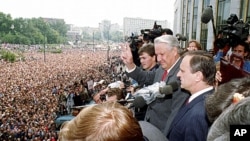
They have been called three days that changed world history. Twenty years ago, communist hardliners tried to mount a military coup to preserve the Soviet Union.
It has only been 20 years since Soviet citizens awoke to find the ballet Swan Lake playing endlessly on their television sets.
Soon the word spread: Soviet leader Mikhail Gorbachev was under house arrest in a Black Sea resort. Hardline communist leaders had ordered tanks and armored personnel carriers to surround Moscow's White House, the seat of power of Russia's new President Boris Yeltsin.
Cautiously at first, then by the thousands, Muscovites poured out of their apartments to stop the tanks.
Within three days, the coup collapsed. In front of KGB headquarters, protesters pulled down the statue of Felix Dzerzhinsky, the founder of the hated Soviet secret police.
Konstantin Eggert, a Russian journalist who covered the popular uprising, recalls the jubilation when people realized Soviet soldiers were moving their tanks in reverse.
"It was a jubilant mood," said Eggert. "These three days were unique in my life in the sense that probably for the first and last time I saw what a people, with a capital P is. And I am very proud of all those Russians who were on the streets of Moscow these days because that was the time when we felt that the country is ours and we really are citizens."
The coup's failure sparked the formal collapse of the Soviet Union four months later.
For Mikhail Shneider, custodian of a memorial to the three Moscow men killed in the coup, the day should be celebrated in Russia with the reverence associated with May 9, the day that Nazi Germany surrendered.
Shneider says that both systems - Communism and Fascism - killed millions, not only in Russia but in neighboring countries. He says this weekend is the anniversary of "the happiest days of my life."
But many Russians do not that share that joy.
This month a nationwide Levada poll found that almost half of respondents said that Russia had gone in the wrong direction since the fateful days of August 1991.
Only 27 percent said they felt it had gone in the right direction.
With the passage of years, memories of the Soviet Union have softened.
Russians now take for granted their freedom to travel overseas, freedom to speak out on the Internet, freedom to consume, and freedom to practice religion of their choosing.
Instead they chafe at what they see around them in modern Russia, high levels of corruption and huge wealth gaps.
Many agree with Prime Minister Putin who has lamented that the collapse of the USSR is the "greatest geopolitical catastrophe" of the 20th century.
But many analysts say that Russia, with its aging and shrinking population, will eventually adjust to its post-Imperial status - the way the French and British did in the 1960s.
"This renewed quality of Russia is still underappreciated by the majority of the population, which still harks back to the late days of the Soviet Union, which is dead anyway," Eggert noted. "And I think at some point in time the Russians will understand you cannot resurrect it. You cannot create a Soviet Union Lite, even if you wanted to. And you have to really move forward."
At the Carnegie Moscow Center, researchers see no turning back for Russia. The boom in international travel and the largely unfettered Internet, are changing Russians.
Natalia Bubnova, the center's deputy director, said that one day the nation will appreciate the heroism of the thousands of Muscovites who left their apartments to face the guns and tanks - unarmed.
"There was a lot of courage, self-sacrifice, determination, and independent action, independent thinking in those days," said Bubnova. "These were the best features demonstrated by people who on their own will risked their lives for the better of the country. This gives hope for the country for the future."
Late Saturday, veterans of that era are to gather at a memorial at a busy Moscow intersection.
They will mark the days when it seemed that tanks would turn back time.
Russia Reflects on 20th Anniversary of Collapse of Communism
- By James Brooke