News / Asia

Russia Slams EU Plan for Trans-Caspian Gas Pipeline

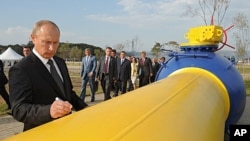
Russia's Prime Minister Vladimir Putin signs an autograph on a natural gas pipeline Sakhalin-Khabarovsk-Vladivostok in the Russian Far East city of Vladivostok during the pipeline's launch ceremony, September 8, 2011.
TEXT SIZE - +

Russia has criticized a European Union decision to open discussions with former Soviet states Azerbaijan and Turkmenistan on a pipeline project that could deliver the Caspian region's vast natural gas reserves directly to Western Europe.

In a statement Tuesday, Russian Foreign Ministry spokesman Alexander Lukashevich said such an agreement would fail to take into account the international legal and geopolitical situation in the Caspian basin.  

He added that the issues concerning the natural gas should be decided only by the five countries bordering the Caspian Sea - Russia, Turkmenistan, Azerbaijan, Kazakhstan and Iran.  He also said the five nations had signed a 2007 agreement that binds them to finding consensus on major issues such as the laying of international pipelines.

The EU on Monday agreed to propose a union-wide treaty supporting the completion of a Trans-Caspian pipeline that would connect Turkmenistan to Azerbaijan via the Caspian Sea.  Gas from that pipeline would be fed into the EU- and U.S.-backed Nabucco pipeline and transported to Western Europe on a route that bypasses Russia.

Russia is currently developing a South Stream pipeline in the same region, which rivals the Nabucco project.

None of the EU nations border the Caspian.  The EU buys about one-quarter of its natural gas from Russia and wants to diversify its purchases to become less dependent on Russia, which has periodically cut off the gas supply.

The Russian Foreign Ministry spokesman also pointed out the possible dangers of building a pipeline in the Caspian, a landlocked body of water that has heightened seismic and elevated tectonic activity.

Some information for this report was provided by AP, AFP and Reuters.

You May Like

Karzai to Discuss Enhancing Defense Ties with India

Afghanistan looking for more military aid as it prepares for withdrawal of NATO forces by next year More

India, China Pledge to Overcome Border Tensions

Indian prime minister and Chinese premier attempt to move past tense standoff in the Himalayas during Delhi talks More

Burmese President Opens US Visit with VOA Town Hall Meeting

Ahead of his meeting with President Obama Monday, Thein Sein answered questions on human rights and economic development in his country More

This forum has been closed.
Comments
     
There are no comments in this forum. Be first and add one

Featured Videos

Your JavaScript is turned off or you have an old version of Adobe's Flash Player. Get the latest Flash player.
Video

Video Boston Bomber Spent 6 Months in Russia’s Most Violent Republic

The news of the Boston Marathon bombings circled the globe, and resonated here in Dagestan, a majority Muslim republic in Russia, on the shores of the Caspian Sea. Last year, Tamerlan Tsarnaev, the older of two brothers suspected of the bombings and a long-time Boston resident, returned to Dagestan, where he had lived for a year during his youth. Dagestan was the land of his maternal ancestors. But in the last two years, this republic of 3 million people has gained notoriety as the region with the highest level of political and religious violence in all of Russia. VOA's James Brooke reports from Makhachkala, Russia.