



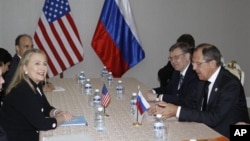
Russian Foreign Minister Sergei Lavrov says his U.S. counterpart Hillary Clinton has indicated that the United States will search for compromise agreements on security and business with Russia.
Lavrov met with Clinton Tuesday in Cambodia's capital, Phnom Penh, on the sidelines of a regional security meeting. He said Secretary Clinton promised that the United States will continue efforts to forge a defense plan for Europe that would protect Russia's security.
He also said he and Clinton discussed business problems that Russian companies encounter on the American market, and that Clinton promised a resolution of these problems.
But he said the two sides have not found common ground regarding the situation in Syria. Russia remains opposed to any foreign intervention in the conflict that has claimed tens of thousands of lives in the past 20 months.
After U.S. President Barack Obama first took office in 2008, his administration announced it would work toward closer ties with Moscow, calling this development a "reset" in relations. But the good intentions stumbled over U.S. plans to build a missile shield in Eastern Europe, which the Kremlin fiercely opposes. Russian President Vladimir Putin also reacted angrily to any U.S. criticism of his government's crackdown on opposition and increased repression of freedoms.
Nikolas Gvosdev, professor of national security studies at the U.S. Naval War College, warns that "compromise" may mean two different things to the U.S. and Russian officials. He says that Lavrov may take it to mean that the United States will not deploy a missile defense in Europe, and that for Clinton it may mean that the missile defense is deployed, but not used until the threat becomes real.
Mark Katz, professor of government and politics at George Mason University, says that even though Moscow is not ready to change its position on Syria, there have been indications that it is growing concerned about whether Russian support for the Syrian government is negatively affecting Russia's image in the Arab world.
He also told said that Moscow seems to hope that President Obama may be more amenable to satisfy Russia on the missile plan after his re-election. However, Katz added it is unlikely that the Obama administration would care to annoy Republicans by reviewing missile defense plans at the time when Democrats need Republican cooperation on domestic budget issues.
Lavrov met with Clinton Tuesday in Cambodia's capital, Phnom Penh, on the sidelines of a regional security meeting. He said Secretary Clinton promised that the United States will continue efforts to forge a defense plan for Europe that would protect Russia's security.
He also said he and Clinton discussed business problems that Russian companies encounter on the American market, and that Clinton promised a resolution of these problems.
But he said the two sides have not found common ground regarding the situation in Syria. Russia remains opposed to any foreign intervention in the conflict that has claimed tens of thousands of lives in the past 20 months.
After U.S. President Barack Obama first took office in 2008, his administration announced it would work toward closer ties with Moscow, calling this development a "reset" in relations. But the good intentions stumbled over U.S. plans to build a missile shield in Eastern Europe, which the Kremlin fiercely opposes. Russian President Vladimir Putin also reacted angrily to any U.S. criticism of his government's crackdown on opposition and increased repression of freedoms.
Nikolas Gvosdev, professor of national security studies at the U.S. Naval War College, warns that "compromise" may mean two different things to the U.S. and Russian officials. He says that Lavrov may take it to mean that the United States will not deploy a missile defense in Europe, and that for Clinton it may mean that the missile defense is deployed, but not used until the threat becomes real.
Mark Katz, professor of government and politics at George Mason University, says that even though Moscow is not ready to change its position on Syria, there have been indications that it is growing concerned about whether Russian support for the Syrian government is negatively affecting Russia's image in the Arab world.
He also told said that Moscow seems to hope that President Obama may be more amenable to satisfy Russia on the missile plan after his re-election. However, Katz added it is unlikely that the Obama administration would care to annoy Republicans by reviewing missile defense plans at the time when Democrats need Republican cooperation on domestic budget issues.