



Russian lawmakers have vowed to respond in kind after the U.S. Congress approved a bill imposing sanctions on Russian officials suspected of human rights violations.
Officials said Monday that Russia's lower house of parliament, the State Duma, will consider imposing some sort of penalty against U.S. citizens that Moscow suspects of human rights violations.
The Duma's international affairs committee chairman, Alexei Pushkov, said the Russian Foreign Ministry already has a confidential list of U.S. nationals who will be banned entry to Russia if lawmakers approve the sanctions. The ministry had earlier denounced the U.S. bill — known as the "Magnitsky Act" — as "an absolutely unfriendly, provocative, unilateral move."
Last week, the U.S. Senate voted to lift trade restrictions on Russia that date back to the Cold War era, normalize trade with Moldova and impose sanctions on Russian officials accused of committing human rights violations. U.S. President Barack Obama has pledged to sign the measure, which cleared the House of Representatives last month.
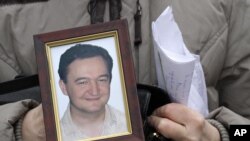
The bill is named after Sergei Magnitsky, a 37-year-old Russian lawyer who was jailed after he denounced what he called a criminal ring of officials who stole $250 million in tax money. He died in prison in 2009.
The Magnitsky Act combines two bills — the Russia and Moldova Jackson-Vanik Repeal and Sergei Magnitsky Rule of Law Accountability Act. One part repeals a Cold War-era provision known as the Jackson-Vanik amendment, which linked favorable U.S. tariffs on Russian goods to the rights of Jews in the Soviet Union to emigrate.
The bill also includes a provision that denies visas and freezes U.S. bank assets of Russian human rights violators. Moscow has expressed anger over the provision, warning that it would harm diplomatic relations with Washington.
Before the vote, Russian Foreign Ministry officials said that if the measure passed, Moscow would respond in what they called an “appropriate manner."
Some information for this report was provided by AP, AFP and Reuters.
Officials said Monday that Russia's lower house of parliament, the State Duma, will consider imposing some sort of penalty against U.S. citizens that Moscow suspects of human rights violations.
The Duma's international affairs committee chairman, Alexei Pushkov, said the Russian Foreign Ministry already has a confidential list of U.S. nationals who will be banned entry to Russia if lawmakers approve the sanctions. The ministry had earlier denounced the U.S. bill — known as the "Magnitsky Act" — as "an absolutely unfriendly, provocative, unilateral move."
Last week, the U.S. Senate voted to lift trade restrictions on Russia that date back to the Cold War era, normalize trade with Moldova and impose sanctions on Russian officials accused of committing human rights violations. U.S. President Barack Obama has pledged to sign the measure, which cleared the House of Representatives last month.
The bill is named after Sergei Magnitsky, a 37-year-old Russian lawyer who was jailed after he denounced what he called a criminal ring of officials who stole $250 million in tax money. He died in prison in 2009.
The Magnitsky Act combines two bills — the Russia and Moldova Jackson-Vanik Repeal and Sergei Magnitsky Rule of Law Accountability Act. One part repeals a Cold War-era provision known as the Jackson-Vanik amendment, which linked favorable U.S. tariffs on Russian goods to the rights of Jews in the Soviet Union to emigrate.
The bill also includes a provision that denies visas and freezes U.S. bank assets of Russian human rights violators. Moscow has expressed anger over the provision, warning that it would harm diplomatic relations with Washington.
Before the vote, Russian Foreign Ministry officials said that if the measure passed, Moscow would respond in what they called an “appropriate manner."
Some information for this report was provided by AP, AFP and Reuters.