


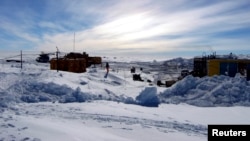
Russian scientists say they might have found new life forms in a fresh-water Antarctic lake that has been sealed off from the world for 14 million years.
Bacterial DNA was discovered in samples of water the Russians took from Lake Vostok last year, when they finally broke through nearly four kilometers of Antarctic ice after a decade of intermittent drilling.
One of the Russian scientists analyzing the water samples - Sergei Bulat of the St. Petersburg Nuclear Physics Institute - told the RIA Novosti news agency that after excluding all possible terrestrial contaminants, the research team has concluded that the bacterial DNA found in the lake's icy darkness "does not match any known species in world databases."
For now, Bulat said, they are calling the life forms "unidentified" or "unclassified." They plan to take more samples from the lake to confirm their find.
But Bulat said he believes the discoveries will give new information about how life can survive in extreme conditions - not only on Earth, but also on distant worlds such as Mars or the moons of Jupiter and Saturn.
British and U.S. research teams have been working to similar ends at other subglacial lakes near the southern pole. The British abandoned their quest last year, but the American team recently drilled through to Lake Whillans and took samples of what they called "living cells" from the icy water. They are still analyzing the find to identify what kinds of bacteria they are and how they manage to live without light or air.
Bacterial DNA was discovered in samples of water the Russians took from Lake Vostok last year, when they finally broke through nearly four kilometers of Antarctic ice after a decade of intermittent drilling.
One of the Russian scientists analyzing the water samples - Sergei Bulat of the St. Petersburg Nuclear Physics Institute - told the RIA Novosti news agency that after excluding all possible terrestrial contaminants, the research team has concluded that the bacterial DNA found in the lake's icy darkness "does not match any known species in world databases."
For now, Bulat said, they are calling the life forms "unidentified" or "unclassified." They plan to take more samples from the lake to confirm their find.
But Bulat said he believes the discoveries will give new information about how life can survive in extreme conditions - not only on Earth, but also on distant worlds such as Mars or the moons of Jupiter and Saturn.
British and U.S. research teams have been working to similar ends at other subglacial lakes near the southern pole. The British abandoned their quest last year, but the American team recently drilled through to Lake Whillans and took samples of what they called "living cells" from the icy water. They are still analyzing the find to identify what kinds of bacteria they are and how they manage to live without light or air.