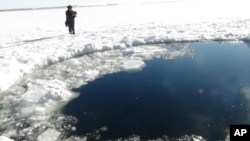
A circular hole in the ice of Chebarkul Lake where a meteor reportedly struck the lake near Chelyabinsk, about 1500 kilometers (930 miles) east of Moscow, February 15, 2013
Russian authorities say divers have explored an icy lake in search of fragments of the huge meteor that exploded above the Ural Mountains, but found nothing.
People in Russia's Chelyabinsk region panicked as the 10-ton meteor lit up the morning sky Friday and exploded with the force of at least 20 nuclear bombs.
The explosion unleashed a shock wave that blew out thousands of windows, damaged buildings and left more than 1,100 people injured. The Interior Ministry said most of the injuries were caused by flying glass.
The regional governor said the damage is estimated at $33 million.
The planetary science director at the U.S. space agency, NASA, says the event was an "exception."
Jim Green said Friday that "fireballs" of some kind happen on a daily basis, but most of them are not seen because they fall over the ocean or in remote areas.
The Russian Academy of Sciences says the meteor entered Earth's atmosphere at a speed of at least 54,000 kilometers per hour.
Its entry occurred just hours before an asteroid known as 2012 DA14 passed between Earth and some orbiting satellites.
NASA said the 45-meter-wide asteroid came as close as 27,000 kilometers above Earth.
February 15, 2013
1/8A meteorite contrail is seen in this frame grab made from a video, on a highway from Kostanai, Kazakhstan, to Chelyabinsk region, Russia, provided by Nasha Gazeta newspaper. A meteor streaked across the sky of Russia's Ural Mountains, causing sharp explosions and reportedly injuring more than 1,000 people, including many hurt by broken glass.
Show moreShow less
2/8فلپائن کے دارالحکومت منیلا میں سمندری طوفان 'راماسن' کے باعث 10 افراد ہلاک ہو گئے ہیں۔
Show moreShow less
3/8Indonesian narcotics police destroy 1.4 tons of seized marijuana from series of raids in Jakarta.
Show moreShow less
4/8Riot police in a police vehicle look out of window grills in front of the courthouse and the Attorney General's office as demonstrators protest against Egyptian President Mohamed Morsi and members of the Muslim Brotherhood near Tahrir Square in Cairo.
Show moreShow less
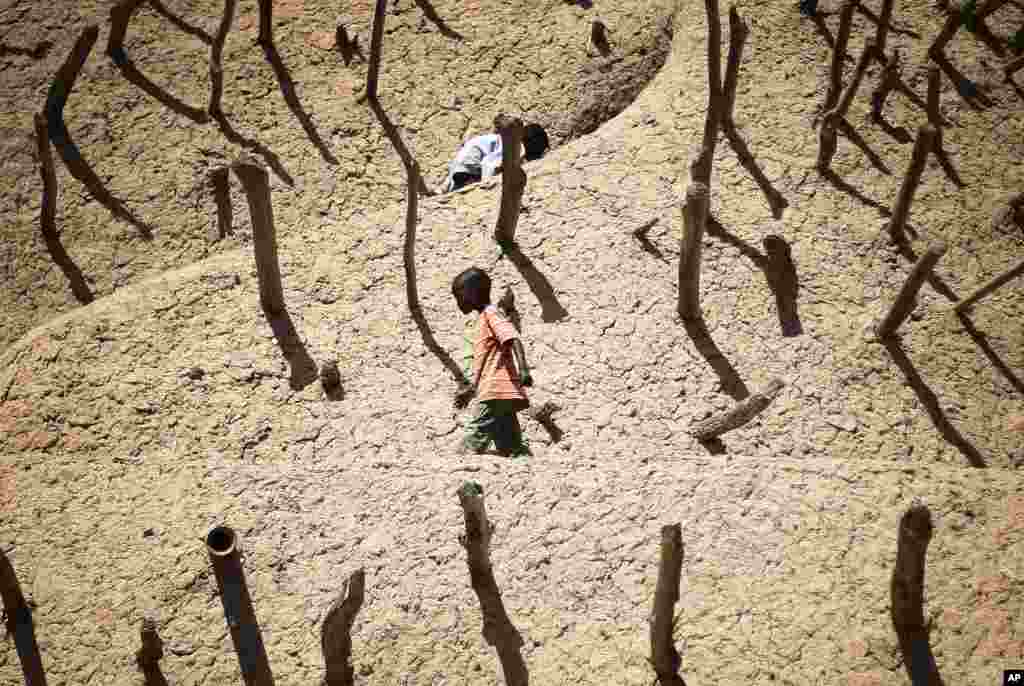
5/8Children walk on the Askia mausoleum, built in 1495 in Gao, northern Mali, one week after a suicide bomber on a motorcycle killed himself attempting to blow up an army checkpoint at the entrance of the town.
Show moreShow less
6/8Libyan security forces check the cars on the side of the highway leading to downtown Benghazi.
Show moreShow less
7/8A woman carries her daughter on her way to fetch water from a nearby tap in a slum on the outskirts of Islamabad, Pakistan.
Show moreShow less
8/8A worker puts the final touch to a train near a replica of Big Ben made with lemons and oranges during the 80th Lemon festival in Menton, France. Some 145 metric tons of lemons and oranges are used to make displays during the festival, which is themed 'Around The World In 80 Days', and runs from February 16 through March 6.
The Voice of America provides news and information in more than 40 languages to an estimated weekly audience of over 326 million people. Stories with the VOA News byline are the work of multiple VOA journalists and may contain information from wire service reports.