


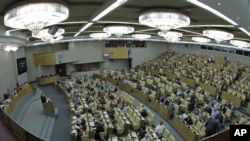
Russia's lower house of parliament has approved a bill that gives the government power to blacklist websites containing what officials consider objectionable material.
The State Duma voted Wednesday on the measure, which proponents say is meant to protect young people from child pornography and information about suicide and drug use.
The move comes one day after the Russian version of the online reference source Wikipedia staged a one-day shutdown to protest the legislation.
Russian Wikipedia's title page on Tuesday featured a blacked-out logo and the message that the legislation could lead to the creation of extra-judicial censorship of the Internet in Russia. It compared the proposals to China's heavily restrictive Internet firewall and called on readers to oppose the measure.
Jay Walsh, a spokesman for the Wikimedia Foundation, which operates Wikipedia, says the Russian editors of the all-volunteer-written reference source decided among themselves to shut down the site for a day. "This is all happening out of the Russian community," he says, adding that the editors fear the definition of objectionable material could be stretched to encompass far more than what is stated in the bill. Noting that Wikipedia is set up as a so-called "free knowledge" project that relies on input from around the world, he says the Russian editors consider the legislation a threat to their freedom to contribute and publish freely.
Nina Ognianova, the Europe and Central Asia Program Coordinator for the Committee to Protect Journalists, says the new legislation is the latest piece in a pattern of Russian crackdowns on freedom of expression, along with higher fines for protest organizers and new regulations on non-governmental groups, or NGO's.
"This is the third wave," she says. "It's a part of a pattern of censoring, stopping the new civil society from being active." She calls the Internet "the last bastion of press freedom and freedom of expression in Russia," a platform for alternative views, in a state where the print and televised media are heavily controlled by the government.
Ognianova says the measure is "vaguely worded" and could be used by state authorities to suppress civil rights defenders and expression of views seen by the government as undesirable.
The amendment is controversial even among Russian authorities. Russia's minister of communications, Nikolai Nikiforov, used his social media Twitter feed Tuesday to criticize the bill - and the Wikipedia shutdown. "I do not support Wiki's decision to close," he wrote. "But this step is an important reaction from society, a sign that we need to amend the bill."
Russia's human rights council, a government advisory group, has also spoken out against the legislation, saying it could lead to "massive blocking" of sites with legal content.
The measure's backers say it is merely meant to protect children from information that harms their health and development.
The State Duma voted Wednesday on the measure, which proponents say is meant to protect young people from child pornography and information about suicide and drug use.
The move comes one day after the Russian version of the online reference source Wikipedia staged a one-day shutdown to protest the legislation.
Russian Wikipedia's title page on Tuesday featured a blacked-out logo and the message that the legislation could lead to the creation of extra-judicial censorship of the Internet in Russia. It compared the proposals to China's heavily restrictive Internet firewall and called on readers to oppose the measure.
Jay Walsh, a spokesman for the Wikimedia Foundation, which operates Wikipedia, says the Russian editors of the all-volunteer-written reference source decided among themselves to shut down the site for a day. "This is all happening out of the Russian community," he says, adding that the editors fear the definition of objectionable material could be stretched to encompass far more than what is stated in the bill. Noting that Wikipedia is set up as a so-called "free knowledge" project that relies on input from around the world, he says the Russian editors consider the legislation a threat to their freedom to contribute and publish freely.
Nina Ognianova, the Europe and Central Asia Program Coordinator for the Committee to Protect Journalists, says the new legislation is the latest piece in a pattern of Russian crackdowns on freedom of expression, along with higher fines for protest organizers and new regulations on non-governmental groups, or NGO's.
"This is the third wave," she says. "It's a part of a pattern of censoring, stopping the new civil society from being active." She calls the Internet "the last bastion of press freedom and freedom of expression in Russia," a platform for alternative views, in a state where the print and televised media are heavily controlled by the government.
Ognianova says the measure is "vaguely worded" and could be used by state authorities to suppress civil rights defenders and expression of views seen by the government as undesirable.
The amendment is controversial even among Russian authorities. Russia's minister of communications, Nikolai Nikiforov, used his social media Twitter feed Tuesday to criticize the bill - and the Wikipedia shutdown. "I do not support Wiki's decision to close," he wrote. "But this step is an important reaction from society, a sign that we need to amend the bill."
Russia's human rights council, a government advisory group, has also spoken out against the legislation, saying it could lead to "massive blocking" of sites with legal content.
The measure's backers say it is merely meant to protect children from information that harms their health and development.