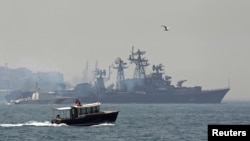
A Turkish Navy cost guard boat (L) escorts the Russian Navy destroyer Smetlivy, in the Bosphorus in Istanbul, July 11, 2012.
MOSCOW — Two Russian Navy ships entered the eastern Mediterranean Wednesday, steaming toward a Russian Navy base at Tartus, Syria. The ships are advance units of a flotilla of 11 warships - one destroyer, five amphibious landing ships, two patrol frigates, two rescue tugs, and one tanker. Several ships carry units of Russian Marines.
It is to be the largest display of Russian naval power in the Mediterranean since the collapse of the Soviet Union two decades ago. And in case the world misses the message, Russia television is broadcasting images of warship after warship steaming out of bases in the Arctic, Baltic and Black seas.
'Sending the message'
In Moscow, Yevgeny Michenko, director of the International Institute for Policies Expertise, says the Kremlin is sending the message that it does not want to see in Syria the kind of Western-led regime change that took place last year in Libya.
“Russia has a crystal clear position," he said in an interview. "It means that Russia does not want to support changes of the Syrian president, and Russia doesn't support any kind of military operation like it was in Libya.”
At a military air show near London, Vyacheslav Dzirkaln, a deputy director of Russia’s Military-Technical Cooperation Service, told reporters that the Russian ships could be used to prevent a Western blockade of Syria.
He said that Russia will fulfill existing contracts to deliver to Syria refurbished helicopters, new air defense systems and spare parts for weapons. He said that no Russian military specialists are now in Syria helping Syria’s army.
But two weeks ago, when Syrian forces used Russian-made missiles to shoot down a Turkish fighter jet, Russian military sources in Moscow gave reporters highly detailed information on the jet’s flight path over the eastern Mediterranean.
Other analysts say Russia’s amphibious ships could be used to evacuate the large numbers of Russian civilians who live in Syria.
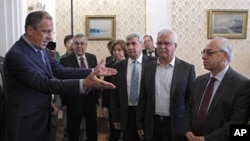
Russian Foreign Minister Sergey Lavrov, left, welcomes a delegation headed by a leader of the Syrian National Council, Abdulbaset Sieda, right, in Moscow, Russia, July 11, 2012.
Power broker
In Moscow, the Kremlin’s ambition to play a power broker in Syria was further underlined Wednesday when Foreign Minister Sergei Lavrov met with the second opposition group to visit Moscow this week.
Lavrov urged the visiting Syrians to unite into one opposition group. He said that Moscow wants "to understand how great the prospects are, and how stable the prospect is, for unification of all opposition groups on the platform of dialogue with the government."
But after the meeting with the Russian Foreign Minister, leaders of the Syrian National Council chose not to be diplomatic.
"Let us be honest," Burhan Ghalioun, a member of the Council Executive Committee told reporters. "We must not hide from the truth. Without Russia's political, cultural, moral and military support, the Syrian regime would not have been able to continue its policy targeted against the Syrian people."
He noted that Russia has twice used its veto in the United Nations Security Council to kill measures that would have pressured Syrian President Bashar al-Assad. "The Syrian people can't understand Russian politics," he said. "How can our friends continue to hand over weapons to that regime, how can they veto in the Security Council?"
Michenko, of the Research Institute, said the Russian Navy presence might pressure the Syrian opposition to negotiate with the Assad government.
“Maybe if we will hold the status quo for a few months, maybe the demands of the Syrian opposition will be more realistic," he said."Maybe when they understand that there is no Libyan scenario, it will be a way for negotiations, for real negotiations.”
Military analysts predict that the Russian Navy battle group will stay near Syria until early September. At that time, several landing ships are expected to return to the Black Sea to participate in annual exercises near Georgia. Four years ago, that former Soviet Republic was briefly invaded by Russian soldiers.