


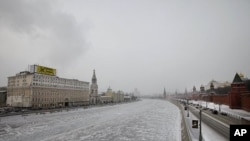
Russia’s democracy movement plans its first big march of the year on Saturday. But, Russia’s opposition faces something stronger than the Kremlin - the Russian winter.
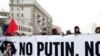
On Saturday, one month before Russians vote for president, Russia’s democracy movement is to hold a mass march through downtown Moscow. It will be the first big rally of the New Year.
Alexei Makarkin, director of the Center for Political Technologies, sees it as a major test of strength.
He says that if the turnout is large, the Kremlin will have to continue to offer concessions to the opposition movement. If the turnout is small, the Kremlin will believe it is weathering the storm.
The Kremlin’s biggest ally may be "General Frost" - an Arctic cold front that is parked over Moscow. Thursday night, five people froze to death in Russia’s capital. In neighboring Ukraine, 100 people have died of cold in recent days.
To adapt, protest organizers cut the march to two kilometers, and told speakers to shorten their speeches. But cold weather is nothing new for Russians, and about 30,000 people have signed on social networks to join the march.
Maxim Trudolubov, editorial page editor of the newspaper, Vedomosti, says turnout is key because the Kremlin only responds to street pressure:
He says that while Russian Prime Minister Vladimir Putin has not entered into a dialogue with the democracy movement, his operatives closely watch the size - and the slogans - of the demonstrations.
The Kremlin is holding a counter rally on Saturday, about five kilometers away. The theme is “anti-Orange protest” and the logo includes a fist squeezing an orange snake. This is a reference to the Orange Revolution - a series of street demonstrations that reversed Ukraine’s tainted presidential elections seven years ago.
The Kremlin’s protest seems to lack spontaneity.
Moscow’s media carry complaints from state employees - teachers, nurses, and post office workers - that they have been ordered to attend. After a state human rights council opened an anonymous hotline for teachers, 140 calls came in.
Patriarch Kirill of the Russian Orthodox Church warned believers this week to beware the protest movement. Noting the chaos caused by the 1917 Communist revolution, he said: “Remember that the loudest yells, the most piercing words, are not always the proper, true and honest ones.”
In an apparent attempt to cut student attendance at opposition protests, Moscow schools will hold a career training day on Saturday.
Mikhail Dmitriev, president of the Center for Strategic Research, warns that, because of a high concentration of universities in Moscow, about one-third of the city’s adult population is aged between 20 and 30.
"You must be aware of the enormous potential for political violence there is in this country today," he said. "It is not much different than the Arab Spring."
He says this group is increasingly politically aware and increasingly demands political liberalization. He says the Kremlin fears that a march of 30,000 people in February's Arctic temperatures could transform into a march of 100,000 in April, springtime in Moscow.
Shift in Attitudes in Yekaterinburg, Russia: