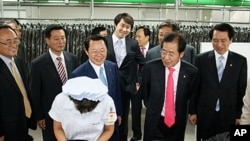



The leader of South Korea’s governing political party made a quick visit north of the demilitarized zone on Friday. The trip to an inter-Korean industrial park is seen as an attempt by the South to improve relations with the communist North.
Some South Korean officials say the half-day visit by a key political figure to the Kaesong industrial complex is significant.
The chairman of the Grand National Party, Hong Joon-pyo, toured the factory park, just north of the border. The industrial zone is the last remaining symbol from inter-Korean rapprochement, which chilled after South Korean President Lee Myung-bak came to power three years ago.
After returning from North Korea Friday afternoon, the chairman of the Grand National Party, Hong Joon-pyo, spoke to reporters.
Hong says the complex is important for economic relations and peaceful cooperation between the two Koreas. He says although he did not meet with any North Korean officials, he believes Pyongyang understands the South Korean government is putting a lot of effort into the project.
Hong says the visit helped him learn about the difficulties South Korean companies have at the joint complex.
The Kaesong industrial park employs nearly 50,000 North Koreans working for about 120 South Korean companies. They make clothes, watches, utensils and other products. The project is one of the few significant sources of hard currency for the impoverished North.
The two Koreas have no diplomatic relations. Tension has been high since two deadly attacks on the South last year blamed on the North.
Pyongyang has repeatedly denied the torpedo attack on a South Korean naval vessel. It says the second incident, an artillery attack on a frontier island, was an act of self-defense in response to South Korean forces firing into disputed waters during a military exercise.
But South Korea recently offered emergency flood relief aid to the North. It also allowed religious groups to visit there.
Buddhist monk Jung In-sung, one the religious leaders who went North on a four-day visit that ended last Saturday, said he wants to see more government, political and religious figures embarking on such trips. He says they are beneficial for strained inter-Korean ties and says senior officials he met with in Pyongyang appear to want to improve the relationship.
Jung and six other South Korean religious leaders met with Kim Yong-nam, the head of North Korea’s parliament.
The visits are taking place amid indications that stalled six nation talks on ending North Korea’s nuclear weapons programs could resume soon.
Envoys from the two Koreas met last week in the Chinese capital, Beijing, their second meeting in two months.
The six-way nuclear talks, involving both Koreas, China, the United States, Japan and Russia have not been held in nearly three years.
S. Korean Ruling Party Boss Makes Brief Visit to North