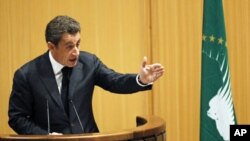
French President Nicolas Sarkozy has cautioned African leaders to respect the peoples’ will or risk being swept aside by a rising tide of public discontent. The warning came as part of Sarkozy’s keynote address to an African Union summit in Addis Ababa.
The words were carefully chosen, aimed at no one in particular, but the intent of Sarkozy’s comments to African heads of state and government could not have been clearer. In this new world of instantaneous communication, social networking and heightened public awareness, leaders can no longer govern in what he called ‘the world of yesteryear’.
The French president said those who ignore the changing times do so at their own peril.
"Either change is inflicted on one, in which case we leave the door open one day or another to violence, or else you anticipate it, guide it, and then it can take place without clashes, without risks and without opening the door to every sort and kind of drift. France wants this peaceful change and will support it."
Leaders of most North African states were conspicuous by their absence at this summit. Egypt, Tunisia, Libya and Algeria were all represented by lower level officials.
At a time when television screens have been filled with angry public demonstrations in north African capitals, Sarkozy warned the more than 30 assembled heads of state they could face a similar fate unless they address people’s aspirations.
"Good governance, democracy, respect for human rights are among many values for which your organization struggles on a daily basis and on which you succeed in pushing forward. These correspond to the deep aspirations of each one of our peoples, as we have been reminded forcefully by recent events in Tunisia and Egypt."
The French leader also warned against the use of force to put down public demonstrations.
"Allow me on this sensitive subject to speak very bluntly. I am going to speak as a friend, because one owes the truth to one's friends. When faced with innocent victims, our consciences cannot but be pricked because violence from whatever sources is never a solution. Because violence only breeds more violence, because violence on all continents engenders misery and suffering."
Sarkozy also singled out Ivory Coast, implicitly criticizing incumbent President Laurent Gbagbo for refusing the step down after his apparent defeat in last November’s presidential runoff election.
"In Cote d’Ivoire, where the freely expressed will of an entire people in an election meant to seal a return to peace is being treated with scorn, France resolutely supports efforts of A.U. and ECOWAS and the U.N. secretary general to ensure that the Ivorian people’s choice, peaceful choice, prevails despite the difficulties and the setbacks."
In a separate summit address, U.N. Secretary General Ban Ki-moon backed the call for a negotiated settlement in Ivory Coast. But Ban said any solution should result in the formation of a government led by challenger Alassane Ouattara.
Both the United Nations and the African Union have recognized Ouattara’s election victory.
Sarkozy Calls on African Leaders to do Better or Risk Public Wrath