A U.S. research institute says satellite images show North Korea could complete construction on a light-water nuclear reactor by the end of next year. But analysts say there is no consensus on what it means for the future of Pyongyang's nuclear weapons program.
The Washington-based Institute for Science and International Technology says imagery taken in May and June shows new construction material has been placed on and near the reactor building at the Yongbyon nuclear complex. It said major external work on the reactor appears to be complete, though the building itself still lacks a dome.
Pyongyang says the new light-water reactor will generate electricity for civilian purposes. However, it could also be used to make the weapons-grade plutonium that North Korea is believed to have used for two nuclear tests.
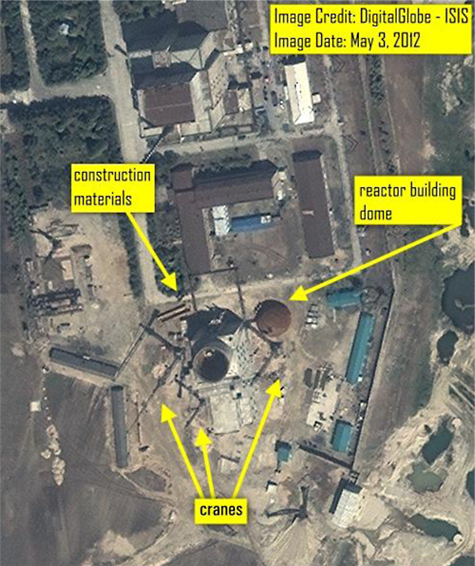 Satellite imagery from May 3, 2012 showing construction materials and support equipment waiting to be placed on the reactor building.
RAND security analyst Bruce Bennett says there is reason to doubt that North Korea intends to use the facility for electricity, since it failed to connect power lines to its original nuclear reactor after having made similar promises.
"It was very clearly for producing nuclear materials as opposed to producing power," says Bennett. "What would be really interesting as this facility gets closer to completion, is to see whether they actually do try to hook it up to the power grid."
Ben Habib, a Korean analyst at Australia's Latrobe University, says a bigger concern may be the nearby uranium enrichment plant, which scientists say could give Pyongyang a second way to make nuclear weapons.
"It's probably unlikely that this light-water reactor is going to be used to make plutonium for nuclear weapons," says Habib. "What is a significant development is what is happening next door at the uranium enrichment facility. It's easier and cheaper to get fissile material through uranium enrichment because it doesn't have to be burned through a reactor like plutonium does."
Habib says ultimately, it may be difficult to know the status of North Korea's nuclear weapons capability unless it conducts a third nuclear test - a step many observers say could come soon.
North Korea is already under numerous international sanctions for its missile and nuclear programs. It reached a deal with the United States in February to suspend those programs in exchange for badly needed food aid. But Washington scrapped the deal after Pyongyang ignored international warnings and launched a rocket in April.
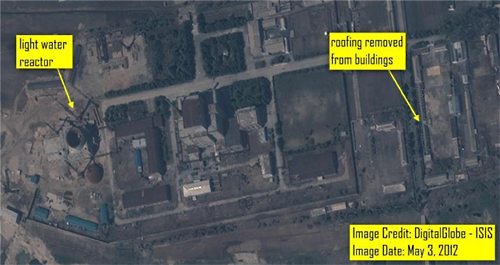
A wide area view of the Yongbyon LWR complex showing ongoing construction work on two buildings north of the reactor building.
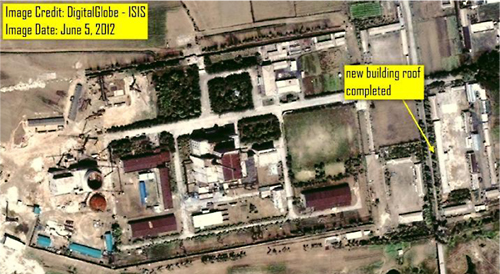
The June 5, 2012 imagery shows the completed external construction of the buildings that have now been combined under a single roof.
The Washington-based Institute for Science and International Technology says imagery taken in May and June shows new construction material has been placed on and near the reactor building at the Yongbyon nuclear complex. It said major external work on the reactor appears to be complete, though the building itself still lacks a dome.
Pyongyang says the new light-water reactor will generate electricity for civilian purposes. However, it could also be used to make the weapons-grade plutonium that North Korea is believed to have used for two nuclear tests.
Satellite imagery from May 3, 2012 showing construction materials and support equipment waiting to be placed on the reactor building.RAND security analyst Bruce Bennett says there is reason to doubt that North Korea intends to use the facility for electricity, since it failed to connect power lines to its original nuclear reactor after having made similar promises.
"It was very clearly for producing nuclear materials as opposed to producing power," says Bennett. "What would be really interesting as this facility gets closer to completion, is to see whether they actually do try to hook it up to the power grid."
Ben Habib, a Korean analyst at Australia's Latrobe University, says a bigger concern may be the nearby uranium enrichment plant, which scientists say could give Pyongyang a second way to make nuclear weapons.
"It's probably unlikely that this light-water reactor is going to be used to make plutonium for nuclear weapons," says Habib. "What is a significant development is what is happening next door at the uranium enrichment facility. It's easier and cheaper to get fissile material through uranium enrichment because it doesn't have to be burned through a reactor like plutonium does."
Habib says ultimately, it may be difficult to know the status of North Korea's nuclear weapons capability unless it conducts a third nuclear test - a step many observers say could come soon.
North Korea is already under numerous international sanctions for its missile and nuclear programs. It reached a deal with the United States in February to suspend those programs in exchange for badly needed food aid. But Washington scrapped the deal after Pyongyang ignored international warnings and launched a rocket in April.
A wide area view of the Yongbyon LWR complex showing ongoing construction work on two buildings north of the reactor building.
The June 5, 2012 imagery shows the completed external construction of the buildings that have now been combined under a single roof.