



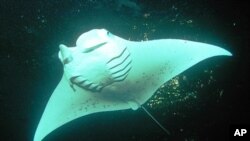
Marine scientists are using satellite technology to track the elusive ocean wanderings of giant manta rays - graceful creatures that ply the world’s seas.
The co-authors of the new study say more measures are needed to protect dwindling worldwide manta populations, but complicating the issue is that almost nothing is known about the day-to-day movements and ecological needs of these enigmatic gentle giants.
To solve some of the mystery, the scientists attached satellite transmitters to six manta rays swimming off Mexico’s Yucatan Peninsula, and then recorded their travels for the next 13 days.
Mantas are the largest species of ray. They can weigh 2.5 tons, and their wing-like fins can span more than 7.5 meters. Filter-feeding manta rays reach their enormous size by feasting on free-floating clouds of fish eggs and microscopic organisms called zooplankton.
The researchers say their new satellite telemetry shows some of the giant rays they studied covered more than 1,100 kilometers during the 13-day study period.
The six mantas spent most of their time cruising around Mexico’s coastal waters where food was plentiful. However, the scientists say the satellite data revealed the majority of the locations were in major shipping routes where the mantas could be hit by passing vessels. Only 11.5 percent of the places where the six rays gathered were located in marine protected areas.
The Swiss-based International Union for Conservation of Nature has listed mantas as “vulnerable” to extinction.
The study's co-authors say research using satellite tracking technology is critical in developing effective conservation and management strategies.
The new study was a collaboration of the Wildlife Conservation Society, Britain’s University of Exeter, and the government of Mexico. It is published in the journal, PLoS One (Public Library of Science One).
Mantas, like all rays, are closely related to sharks. They have the highest brain-to-body ratio of all shark and ray species known to science.
Despite their imposing size, manta rays pose no threat to humans. They do not have a potentially deadly barbed tail like a stingray, or teeth like a shark.
The enormous ocean giants filter feed just like their colossal whale-shark cousins, or baleen whales, which are mammals. Mantas give birth to live young, having one or two pups roughly once every one or two years.
The co-authors of the new study say more measures are needed to protect dwindling worldwide manta populations, but complicating the issue is that almost nothing is known about the day-to-day movements and ecological needs of these enigmatic gentle giants.
To solve some of the mystery, the scientists attached satellite transmitters to six manta rays swimming off Mexico’s Yucatan Peninsula, and then recorded their travels for the next 13 days.
Mantas are the largest species of ray. They can weigh 2.5 tons, and their wing-like fins can span more than 7.5 meters. Filter-feeding manta rays reach their enormous size by feasting on free-floating clouds of fish eggs and microscopic organisms called zooplankton.
The researchers say their new satellite telemetry shows some of the giant rays they studied covered more than 1,100 kilometers during the 13-day study period.
The six mantas spent most of their time cruising around Mexico’s coastal waters where food was plentiful. However, the scientists say the satellite data revealed the majority of the locations were in major shipping routes where the mantas could be hit by passing vessels. Only 11.5 percent of the places where the six rays gathered were located in marine protected areas.
The Swiss-based International Union for Conservation of Nature has listed mantas as “vulnerable” to extinction.
The study's co-authors say research using satellite tracking technology is critical in developing effective conservation and management strategies.
The new study was a collaboration of the Wildlife Conservation Society, Britain’s University of Exeter, and the government of Mexico. It is published in the journal, PLoS One (Public Library of Science One).
Mantas, like all rays, are closely related to sharks. They have the highest brain-to-body ratio of all shark and ray species known to science.
Despite their imposing size, manta rays pose no threat to humans. They do not have a potentially deadly barbed tail like a stingray, or teeth like a shark.
The enormous ocean giants filter feed just like their colossal whale-shark cousins, or baleen whales, which are mammals. Mantas give birth to live young, having one or two pups roughly once every one or two years.