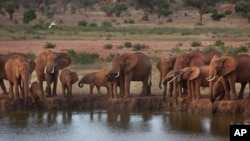
Elephants gather at dusk to drink at a watering hole in Tsavo East National Park, Kenya, March 25, 2012.
Wildlife experts and conservationists say African elephants are under unprecedented attack. Organized gangs have turned wildlife ranges into war zones as they hunt for the creature’s prized ivory. The trend has raised questions about whether international efforts to protect them are helping or making the problem worse.
African elephants splash in ponds of water deep inside the Dzanga Sangha Reserve in the Central African Republic.
Andrea Turkalo, a scientist for the World Conservation Society, travels through the park, first by car, then on foot, hacking a path through the jungle with a machete.
About 50 elephants mill about. The majestic and iconic creatures appear safe here, but Turkalo says the threat has never been greater. “It’s bad news everywhere. They’re being poached everywhere. And I think people have to realize that. That whole situation has changed," he said.
But why has poaching for elephant ivory skyrocketed in recent years? The commodities have always been prized in Asian countries, where the appetite for them has also surged.
This will be a central question during a March gathering of the Convention on International Trade in Endangered Species of Wild Fauna and Flora, or CITES.
CITES was formed more than 30 years ago to ensure that international trade does not threaten the survival of wild animals and plants.
Nations voluntarily sign onto the convention. CITES Secretary-General John Scanlon says parties have legal obligations and if they do not comply with the convention they face possible suspension in the trade of some 35,000 species.
“So it is very much a hard law international convention and in fact it stands out amongst all of the conventions dealing with the environment for the teeth that it has,” he said.
Ivory that was confiscated in Singapore in 2002 and returned to Kenya was burned during the first African Elephant Law Enforcement Celebrations held on July 20, 2011 at Kenya Wildlife Services Field Training School at Manyani, Kenya. (Steve Njumbi / IFAW)
Stockpiles from South Africa, Zimbabwe, Namibia and Botswana were traded to Japan and China.
176 parties have signed on. But some countries in sub-Saharan Africa blame CITES itself — at least in part — for the surge in elephant poaching and illegal ivory trade.
CITES banned the trade in newly obtained ivory in 1989, but since then it has twice allowed African countries to legally trade ivory from elephants that died of natural causes.
Debate
Critics argued the so-called “one-off” sales wrongly sent a signal that it was legal to trade in ivory again and made it easier to launder illegal ivory with legal ivory. Opponents of the sales — like the Kenyan government — say this fueled demand and caught the attention of organized gangs that have set out to cash in.
Authorities say the new, highly-sophisticated gangs are equipped with weapons of war and increasingly brazen as they hunt for ivory and rhino horns — now worth more than gold in the Asian black market.
"If nothing is done in the coming CITES meeting to deal with the issues to enforcement and deal with the issues of demand, many countries in Africa will lose their entire elephants population,” says Patrick Omondi, head of Kenya’s wildlife management and conservation.
Kenya has proposed that CITES place a moratorium on any more legal ivory trade until at least 2017.
Legal sale
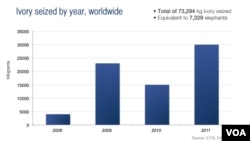
Ivory seized by year, worldwide, from 2008 to 2012.
Tanzania, however, has asked CITES to allow it to sell 100 tons of legal ivory, arguing the government needs the money to fight well-financed and heavily-armed poachers.
“We are experiencing some of the most defining moments in our conservation efforts because of the increased poaching,” says Lazaro Nyalandu, Tanzania’s deputy minister of natural resources and tourism.
Nyalandu says whether or not previous legal sales caused the spike in poaching, his country needs the proceeds to better equip its game rangers.
CITES Secretary-General Scanlon says the legal ivory sales were part of an “experiment” to see if a fresh supply would help drive down the cost and demand. He said statistics on the sales have been inconclusive.
Out in the wild, conservationists like Turkalo believe it all has to do with more than protecting wildlife.
"It’s trade and it’s about money and that’s the way the world works. And I think a lot of us are very naive in thinking that we can decide all these things at national meetings, international meetings,” he says.
CITES is currently considering proposals by countries on both sides of the ivory-sale issue and will issue its recommendations in January.