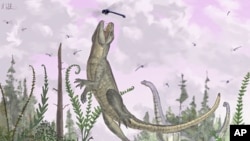



Scientists have unearthed the fossil of a crocodile-like animal in Africa that had mammal-like teeth, suggesting that the prehistoric creature could bite and chew its food - an ability modern crocodiles do not possess.
Paleontologists discovered the remains of the unique creature in a river bank in southwestern Tanzania, where they have dug up other fossils from the mid-Cretaceous period more than 100 million years ago.
The ancient reptile was smaller than a house cat, its skull fitting easily in the palm of one's hand. Bony plates ran down the tail and back, much like modern crocodiles.
But researchers like Patrick O'Connor of Ohio University say the animal's most striking feature is its teeth.
"If someone were just to describe those teeth, the shapes and how they interact with one another or work together, most people would read that as a very mammalian-like dental series," said Patrick O'Connor.
O'Connor led the international team of paleontologists that found a complete specimen of the crocodilian reptile in 2008, and has since recovered portions of seven other creatures.
O'Connor says the latest fossil find - an intact skull - includes sharp incisors at the front of its mouth for tearing food, and interlocking upper and lower molars at the back of the jaw that were used for grinding.
Modern crocodile teeth, by contrast, are of equal size and all are extremely sharp, according to Paul Filmer, program director of geology and paleobiology at the U.S. National Science Foundation, which co-funded the expedition with the National Geographic Society.
"The crocodilians with which you and I are familiar have a very characteristic smile, as it were," said Paul Filmer. "The teeth or the dentition that they have is mainly a row of conical teeth which may vary a little bit in size and angle, but they're pretty much all the same and they basically serve that function which is [to] grab and tear."
Scientists say modern crocodiles did not evolve from the prehistoric crocodile-like creature that was a species of ancient reptiles called notosuchians crocodyliform that died out around the same time that other land-dwelling dinosaurs became extinct.
Paleontologists say notosuchians are characterized by a variety of different tooth structures and patterns.
Researcher Patrick O'Connor says the 100-million-year-old reptiles, which flourished across a southern landmass the predated the African continent, probably filled a unique ecological niche.
"Maybe there was a certain place in the ecology or in the environment where these animals lived that allowed them to experiment with the shape of the teeth," he said. "And as evolution works, if that was a successful experiment, then a group could go on and have a very long history."
O'Connor says studying the notosuchians and their surprising dental features could help explain how modern crocodiles developed their sharp-toothed smile.
An article describing the discovery of the reptilian fossil with mammalian teeth is published this week in the journal Nature.
Scientists Discover Crocodile Fossil with Mammalian Teeth