



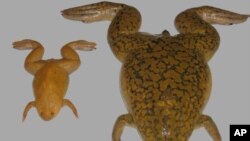
Scientists have completed the first genetic blueprint of an amphibian, a clawed African frog, which they say is among the last vertebrates to have its DNA sequenced. Researchers hope the work will shed light on the effects of chemicals called endocrine disruptors on humans and help preserve endangered frog species.
Xenopus tropicalis, often called the Western clawed frog, is one of 20 frog species native to sub-Saharan Africa. Its cousin, X. laevis, is now commonly used in laboratories where studies of its large eggs have helped scientists understand the development of fertilized eggs into embryos.
With its genetic sequence now in hand, the smaller tropicalis should help researchers link genetic changes to the developmental milestones in both species as well as in human embryos, which scientists say are more difficult to study.
Uffe Hellsten, with the Department of Energy Joint Genome Institute in Walnut Creek, California, is one of almost 50 scientists worldwide who helped to create the new catalog of the frog's DNA.
Hellsten says the genetic blueprint opens up several other avenues of research by comparing the tropicalis' genes to those of other vertebrates, including humans. "To mention an example, we have found that about 80 percent of all genes that are known to be associated with human disease have a counterpart in frog. Obviously this opens up the possibility of enhancing our understanding of many of those diseases by studying disease models in frog," he said.
Scientists say tropicalis and humans share 1,700 disease-related genes. They say the frog gives scientists a living laboratory in which to learn how those genes cause illness in people.
Hellsten notes that a comparison of regions around specific genes in the frog, chicken and human shows that all three genomes are remarkably similar. He says scientists are looking at fragments of an ancient chromosome that belonged to the common ancestor of all mammals, birds and amphibians before they diverged 360 million years ago.
Hellsten says tropicalis has about 20,000 genes compared to 23,000 genes in human. The frog shares many biological features with humans, including development of nervous, skeletal and immune systems.
In general, frogs are popular research subjects because they take up less room in the lab and have a shorter lifecycle, as little as 4 months, and their eggs are relatively easy to manipulate.
Frogs rose to prominence as prized experimental animals in the 1940's when scientists discovered they could inject the urine of pregnant woman into a frog and it would produce eggs.
Since then, there's been interest in frogs as models for the study of endocrine disruptors. These artificial chemicals - found in industrial products such as agricultural insecticides - often pollute the lakes and streams in which the frogs live.
The endocrine disruptors mimic the frogs' reproductive hormones, causing bizarre deformities in developing amphibians, including the growth of female sex organs in male frogs. The chemicals are also blamed for causing a major decline in frog populations over the past several decades.
As a result, says Hellsten, scientists are eager to figure out exactly how these chemicals do their damage. "We can hope to actually study the effect of such disruptors at a molecular level and understand better how they interact. And research like this could hopefully in time not only help humans, because humans are also sensitive to such chemicals, but also help preserve the frog diversity," he said.
The complete genetic road map of the African frog Xenopus tropicalis is published this week in the journal Science.