News / Science & Technology

Scientists Find Milky Way’s Spine

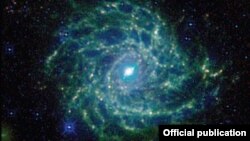
The Milky Way’s 'backbone' structure contains about 100,000 stars' worth of gas and dust. Credit: Jarret et al. 2012 Wise Enhanced Resolution Galaxy Atlas
TEXT SIZE - +
Rosanne Skirble
Scientists have announced the discovery of a spine-like structure within the Milky Way that might help explain the dynamics of galactic formation.

The Milky Way is the spiral galaxy we live in and is one of billions of such vast pinwheel-like formations scattered throughout the universe, each containing hundreds of billions of stars. 
 
Harvard University astronomy professor Alyssa Goodman is an expert on star formation. Not long ago, she and her colleagues at the Harvard Smithsonian Center for Astrophysics were reviewing data of a dense cosmic cloud nicknamed Nessie by the scientist who first described it.

Scientists Find Milky Way’s Spine
Loading
12:00:00 / -:--:--

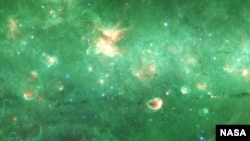
Goodman’s team saw a new feature in the cloud, a tendril of dust and gas about 1,000 light years long, that made Nessie eight times longer than it was previously thought to be.
 
Researchers have identified a new spine-like structure of our Milky Way galaxy - a long, dense tendril of dust and gas. Credit: NASA/JPL/SSCResearchers have identified a new spine-like structure of our Milky Way galaxy - a long, dense tendril of dust and gas. Credit: NASA/JPL/SSC
x
Researchers have identified a new spine-like structure of our Milky Way galaxy - a long, dense tendril of dust and gas. Credit: NASA/JPL/SSC
Since we live inside the Milky Way, it can be difficult for us to determine its exact structure. Goodman says this is the first time that scientists have seen such a delicate piece of the galactic skeleton.

“What we’ve added to this is the idea that there might be these very sharp, dense features that we can pick out of the data and that that will just add another tool to the arsenal of trying to figure out the structure of the galaxy we live in.”
 
Computer simulations of galaxy formation show webs of filaments within spiral disks.  It is very likely that the newly discovered Milky Way feature is one of these skeletal filaments.

“If we combine this information in a statistical way, we can probably build a pretty good three-dimentional model of the galaxy,” Goodman says. The new filament is likely made from high density gas, the type that forms stars.
 
The discovery is an interesting demonstration of what’s called open science. Goodman and nine collaborators are writing the paper on the find, which the public can review as it evolves online at authorea.com.

“That means that as we work on the paper, which is about 90 percent done at this point, the whole world can see it. They can watch us work on it.”
 
Goodman presented her work at the American Astronomical Society meeting in Long Beach, California.


This article corrects an error in the original story describing the newly-calculated length of the Nessie spine structure.

You May Like

Experts Weigh In on Challenges of Closing Guantanamo Prison

Former chief military prosecutor at Guantanamo delivers petition to White House with more than 370,000 signatures, demanding facility be closed down immediately More

Karzai to Discuss Enhancing Defense Ties with India

Afghanistan looking for more military aid as it prepares for withdrawal of NATO forces by next year More

India, China Pledge to Overcome Border Tensions

Indian prime minister and Chinese premier attempt to move past tense standoff in the Himalayas during Delhi talks More

Burmese President Opens US Visit with VOA Town Hall Meeting

Ahead of his meeting with President Obama Monday, Thein Sein answered questions on human rights and economic development in his country More

This forum has been closed.
Comments
     
There are no comments in this forum. Be first and add one

Featured Videos

Your JavaScript is turned off or you have an old version of Adobe's Flash Player. Get the latest Flash player.
Video

Video US Oil Surge Could Impact Mideast Geopolitics

The United States will account for a third of new oil supplies over the next five years, and will become energy self-sufficient in 20 years, according to a new report by the Paris-based International Energy Agency (IEA). Although U.S. oil imports from Arab Gulf countries increased last year, analysts predict the U.S. will lose its dependence on Middle East imports, which is expected to have a huge impact on international relations and the balance of power. VOA's Henry Ridgewell reports.