


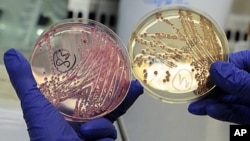
Scientists may have found an effective new weapon against antibiotic-resistant bacteria. They did not create a new drug to kill these microbes; instead, they found a way to interfere with the metabolism of the extra-hardy bacterium - E. coli in this case - so that the germs became more vulnerable to existing antibiotics.
Scientists believe they have discovered the so-called superbugs’ Achilles heel, a biochemical weakness in the bacteria that makes it possible - in effect - to "kick them while they are down.”
Researchers, led by Jim Collins of Harvard's Wyss Institute for Biotechnology in Massachusetts, altered the E. coli's bacterium’s metabolic processes, interfering with its normal production of waste products called ROS, short for "reactive oxygen species."
Normally, the E. coli bacterium would be able to break down the ROS they produce. But Collins, also a professor of biomedical engineering at Boston University, says that by tweaking a number of genes to increase ROS production, scientists forced waste levels within the cell to become destructive, weakening the superbugs and making them vulnerable to antibiotics.
Researchers used a computer model to map out the metabolic activity of the E. coli bacterium, selectively deleting genes to see which ones might be involved in increasing the production of ROS, and then zeroing in on the most likely ROS genes.
After switching off these ROS genes and successfully increasing the bacterium's waste production, Collins says scientists conducted experiments with a drug-resistant strain of E. coli, targeting certain areas in the bacterium with standard antibiotics and bleach.
“And in each case, we found the targets could boost the killing efficacy from tenfold to a thousand fold," said Collins.
Collins says his team's approach actually mimics how some antibiotics are believed to kill bacteria. He cautions that the new strategy is not a “magic bullet” that can solve the growing problem of antibiotic-resistant bacteria -- a problem that is undermining traditional treatment strategies against lethal diseases such as tuberculosis and pneumonia. But Collins believes the discovery could strengthen our existing arsenal of drugs.
“Where this can help address the problem of growing antibiotic resistance is that we’re, with this approach, serving to boost the effectiveness of our existing antibiotics. And we have preliminary data that indicate that this approach can serve to resensitize resistant strains to antibiotics to which they’ve grown resistant," he said.
In other words, there could soon be a pill that would cause drug-resistant bacteria to lose their resistance and allow potentially life-threatening infections to respond to standard antibiotic treatment.
An article describing a new method for fighting antibiotic-resistant microbes is published in the journal Nature Biotechnology.
Scientists believe they have discovered the so-called superbugs’ Achilles heel, a biochemical weakness in the bacteria that makes it possible - in effect - to "kick them while they are down.”
Researchers, led by Jim Collins of Harvard's Wyss Institute for Biotechnology in Massachusetts, altered the E. coli's bacterium’s metabolic processes, interfering with its normal production of waste products called ROS, short for "reactive oxygen species."
Normally, the E. coli bacterium would be able to break down the ROS they produce. But Collins, also a professor of biomedical engineering at Boston University, says that by tweaking a number of genes to increase ROS production, scientists forced waste levels within the cell to become destructive, weakening the superbugs and making them vulnerable to antibiotics.
Researchers used a computer model to map out the metabolic activity of the E. coli bacterium, selectively deleting genes to see which ones might be involved in increasing the production of ROS, and then zeroing in on the most likely ROS genes.
After switching off these ROS genes and successfully increasing the bacterium's waste production, Collins says scientists conducted experiments with a drug-resistant strain of E. coli, targeting certain areas in the bacterium with standard antibiotics and bleach.
“And in each case, we found the targets could boost the killing efficacy from tenfold to a thousand fold," said Collins.
Collins says his team's approach actually mimics how some antibiotics are believed to kill bacteria. He cautions that the new strategy is not a “magic bullet” that can solve the growing problem of antibiotic-resistant bacteria -- a problem that is undermining traditional treatment strategies against lethal diseases such as tuberculosis and pneumonia. But Collins believes the discovery could strengthen our existing arsenal of drugs.
“Where this can help address the problem of growing antibiotic resistance is that we’re, with this approach, serving to boost the effectiveness of our existing antibiotics. And we have preliminary data that indicate that this approach can serve to resensitize resistant strains to antibiotics to which they’ve grown resistant," he said.
In other words, there could soon be a pill that would cause drug-resistant bacteria to lose their resistance and allow potentially life-threatening infections to respond to standard antibiotic treatment.
An article describing a new method for fighting antibiotic-resistant microbes is published in the journal Nature Biotechnology.