


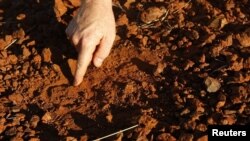
SYDNEY – Scientists at an international symposium in Australia say soil degradation is posing significant challenges for the future of humanity and the planet. The conference is examining the importance of soil security in fighting the effects of climate change and protecting food supplies in poorer countries.
Conference organizers say soil degradation is a more serious threat to human health than climate change, yet it is rarely discussed in the media or by governments.
Experts from around the world have gathered at the University of Sydney to discuss improving the way soil absorbs and retains carbon, which provides energy to plants and other biological processes.
“We realize that soil carbon itself is a lynchpin in securing soil for the world, so basically by increasing our carbon we can contribute to lots of global problems like food security, water security, energy security, climate change mitigation [and] biodiversity protection,” said Soil Science Professor Alex McBratney, who teaches at the University of Sydney.
The degradation of soil is caused by a combination of climate change, intensive farming and other factors. Once it loses its quality, producing more abundant harvests becomes much harder because of the lack of nutrients.
Iowa State University Sociology, Agriculture and Life Science Professor Cornelia Flora says it is a worldwide problem.
“Sub-Saharan Africa has huge problems of highly degraded soils. Australia has some real problems as well," Flora said. "Australia has the scientific capability and the local involvement, I believe, to address it relatively quickly. I think China is going to have real problems in terms of soil degradation and soil quality, and their very fast and unplanned urbanization will make it even harder for them in the future.”
The Sydney conference has called for global action to produce a coherent soil security strategy to ensure the supply of food, and to enhance the sequestration of carbon into the ground, which it is argued would reduce the impact of greenhouse gas emissions.
Conference organizers say soil degradation is a more serious threat to human health than climate change, yet it is rarely discussed in the media or by governments.
Experts from around the world have gathered at the University of Sydney to discuss improving the way soil absorbs and retains carbon, which provides energy to plants and other biological processes.
“We realize that soil carbon itself is a lynchpin in securing soil for the world, so basically by increasing our carbon we can contribute to lots of global problems like food security, water security, energy security, climate change mitigation [and] biodiversity protection,” said Soil Science Professor Alex McBratney, who teaches at the University of Sydney.
The degradation of soil is caused by a combination of climate change, intensive farming and other factors. Once it loses its quality, producing more abundant harvests becomes much harder because of the lack of nutrients.
Iowa State University Sociology, Agriculture and Life Science Professor Cornelia Flora says it is a worldwide problem.
“Sub-Saharan Africa has huge problems of highly degraded soils. Australia has some real problems as well," Flora said. "Australia has the scientific capability and the local involvement, I believe, to address it relatively quickly. I think China is going to have real problems in terms of soil degradation and soil quality, and their very fast and unplanned urbanization will make it even harder for them in the future.”
The Sydney conference has called for global action to produce a coherent soil security strategy to ensure the supply of food, and to enhance the sequestration of carbon into the ground, which it is argued would reduce the impact of greenhouse gas emissions.