News / Africa

Scientists Unravel Chocolate's Genetic Code

Small farmers expected to benefit from better cacao trees

Scientists have unraveled the genetic code of chocolate, which could lead to an improved yield for farmers worldwide whose livelihoods depend on seeds from the cacao tree.

Multimedia

Audio
TEXT SIZE - +

Chocolate lovers around the world take note: two separate groups of scientists have unraveled the genetic code of your favorite sweet.

It's good news for the millions of small farmers in Africa, Asia and Latin America whose livelihoods depend on the seeds of the cacao tree.

Candy is serious business. The world's top-10 confectioners sold more than $40 billion of it in 2005.

But many of the more than five million farmers worldwide who produce cocoa, the main ingredient in chocolate, are living in poverty.

Yield gap

One reason for that is that their farms are not very productive, according to Howard-Yana Shapiro, head of plant research for the US-based candy giant, Mars Inc. Shapiro says the average West African cacao tree farmer produces only about 400 kilograms of cocoa beans per hectare.
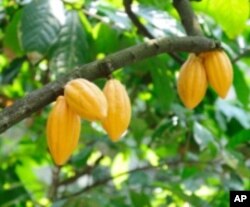
Each year farmers lose about a third of their harvest to pests and fungal diseases. The genome data is expected to help relieve the problem.

"There's a yield potential of maybe 4,000 kilos, 10 times what the average is in West Africa," he says. "We saw the disparity."

To reduce that disparity, Mars helped fund a project to sequence the genome of the cacao tree. The Mars project sequenced the most common variety. French researchers led a separate effort focusing on the high-quality Criollo variety.

Cocoa disease

Genome data is expected to help with some of the most common problems facing cacao growers. Each year farmers lose about a third of their harvest to pests and fungal diseases, says Bill Guyton, president of the World Cocoa Foundation, an industry-sponsored group promoting sustainable cocoa farming.

"This type of program we feel is going to be very beneficial in helping to breed trees that are more tolerant or resistant against some of the fungal pests," he says. And with better productivity, he adds, farmers can earn more money and improve their social conditions.

Many of the five million farmers worldwide who produce cocoa, the main ingredient in chocolate, are living in poverty.

Mars team leader Shapiro says it's a win-win both for the company and for cocoa farmers.

"We want to be in business sustainably in the future. We want to have certified cocoa that is sustainably grown. We want the farmers to have a sustainable life. We don't want them to all have to move to the city."

The genome data will be publically available without restrictions or patents. Shapiro expects improved cacao trees to start reaching farmers in about three years.

You May Like

Karzai to Discuss Enhancing Defense Ties with India

Afghanistan looking for more military aid as it prepares for withdrawal of NATO forces by next year More

India, China Pledge to Overcome Border Tensions

Indian prime minister and Chinese premier attempt to move past tense standoff in the Himalayas during Delhi talks More

Burmese President Opens US Visit with VOA Town Hall Meeting

Ahead of his meeting with President Obama Monday, Thein Sein answered questions on human rights and economic development in his country More

This forum has been closed.
Comments
     
There are no comments in this forum. Be first and add one

Featured Videos

Your JavaScript is turned off or you have an old version of Adobe's Flash Player. Get the latest Flash player.
Video

Video Valley Fever Raises Concerns in California, Arizona

A longstanding health problem in California's Central Valley has worsened in recent years, leading health officials to order the relocation of 3,000 prisoners from two state prisons. But the disease affects much of the population in some rural communities and, Mike O'Sullivan reports, while it often goes unnoticed, it sometimes can be devastating for patients.