Scientists Warn of Reef Peril at Australian Summit
A clam is seen among the corals at the Great Barrier Reef in Great Keppel island, Australia, April 7, 2010.
SYDNEY — A document signed by more than 2,500 scientists at the International Coral Reef Symposium in Cairns, Australia said that climate change is a greater threat to coral reefs than pollution and overfishing. Marine scientists are also warning that the Great Barrier Reef off the coast of Australia's Queensland state will degenerate if the oceans continue to acidify.
The repeated warning from delegates is that manmade climate change is posing a serious risk to coral expanses across the planet. Marine scientists say other factors, such as pollution and increased shipping, also present risks.
The head of the U.S. National Oceanographic and Atmospheric Administration, Dr. Jane Lubchenco, said Australia’s Great Barrier Reef is facing particular threats.
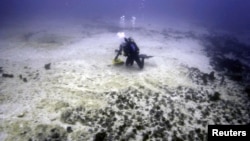
A diver inspects damage caused by a Chinese bulk coal carrier that ran aground on the Great Barrier Reef, east of Great Keppel Island, April 13, 2010.
“The Great Barrier Reef is a obviously spectacular place and thanks to the Great Barrier Reef Marine Park Authority, it has been relatively well managed. It's really a model that has been emulated elsewhere," said Lubchenco. "Part of what makes a healthy reef is not only paying attention to activities on the water and under the water, but land, what's happening on the land, and how much sedimentation, how much pollution is washing into the reef and of course that's an ongoing concern for the Great Barrier Reef.”
Researchers warn that the Great Barrier Reef that stretches down Australia’s northeast coast will not be the spectacular underwater paradise it is now if the oceans continue to acidify.
Carbon emissions
Scientists believe that carbon emissions from the burning of fossil fuels are making the oceans more acidic.
Dr. Lubchenco said that without international action on climate change the future for the coral reefs around the world is uncertain.
“When oceans soak up carbon dioxide, it makes them more acidic and that is problematic for many plants and animals in the ocean, especially those that have shells or skeletons made of calcium carbonate," said Lubchenco. "Oysters, mussels, clams, or crabs, lobsters, and many of the microscopic plants, not to mention coral reefs, are all under threat from increasing ocean acidification.”
The conference in Cairns has also heard that more than 85 percent of coral reefs in the waters of Indonesia, Malaysia, Papua New Guinea, the Philippines, Solomon Islands and East Timor are threatened by the activities of local communities. The study by the World Resources Institute and the USAID Coral Triangle Support Partnership is calling for urgent action.
Too late?
The United Nations has also warned that the Great Barrier Reef is at risk, while some marine scientists said it may already be too late to save it due to rising levels of shipping, offshore gas and oil exploration and port expansion along the Queensland coast.
By 2020 it is estimated that 7,000 ships will travel across the reef every year, as the export of Australia’s natural resources intensifies.
The Australian government has said it was “committed to ensuring the best possible protection and management” of the reef, which is the world's largest coral reef system and is a multi-billion dollar tourist attraction.