



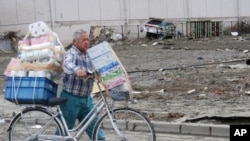
As search and rescue efforts continue in northeastern Japan, following the country's worst natural disaster, millions of survivors there are trying to get on with life.
Many of are facing scarcities of daily necessities and spending much of their waking hours waiting in lines. It is a situation younger Japanese have never faced and only have heard about from their parents and grandparents who survived adversity during and after World War II.
Along the estimated 600 kilometers of coastline devastated by tsunami, the city of Sendai is the most prominent place. Its sea port and airport have been destroyed and no trains are running through any of its rail stations. They all were critical links for the city's infrastructure.
Related video report by Henry Ridgewell
The killer waves reached three kilometers inland here, leveling buildings and trees.
|
Aid Sent and Offered to Japan
|
Half of the city's one-million people have no electricity in their homes. Hundreds of thousands of residences and businesses are also without water.
Although downtown Sendai suffered some quake damage, it still essentially looks like a modern Japanese city, protected by its relative elevation. A limited amount of commerce continues, in an attempt to supply the stunned population with basic necessities.
Keiko Tanaka, six months pregnant, walks with her mother along a street in central Sendai, carrying a big box loaded with spinach, lettuce and onions. They had waited in line at a green grocer for 30 minutes and said the price of vegetables has doubled since Friday.
Tanaka says they are trying to stock up while they can.
Tanaka says although the interior of her home is a mess because of the quake, she feels lucky to live in this part of the city that still has electricity and running water. But her family is worried how long that will last, especially with scheduled rolling blackouts beginning across the country and official predictions of a magnitude seven aftershock coming any day.
Vegetable shoppers are not the only ones waiting in line. Hundreds of people can be seen patiently waiting to get into the very few clothing, hardware and convenience stores still open.
For drivers, finding an open gasoline station has become nearly impossible. The wait to fuel up can extend for hours.
Nearly all restaurants are shuttered. But in central Sendai, a branch of the Nakau beef bowl restaurant chain has stayed open. It is offering only one menu item - curry wheat-flour noodle soup. Every meal includes a cup of free hot water.
Manager Akihiko Yamaguchi says business has been predictably brisk since the earthquake struck, knocking out most competitors.
Yamaguchi says they have decided to remain open as long as possible to give the people of Sendai encouragement to try to carry on.
Residents, despite their weariness, express confidence Sendai will again thrive, noting the city has faced adversity before during its 400-year history.
Twenty percent of Sendai was destroyed by American bombers during World War II. It managed to rebuild, becoming the economic hub for this region of Japan.
Images from Miyagi Prefecture, Sendai, Japan (photos by S.L. Herman)