News / Middle East

US Lawmakers Seek Details of Iran Nuke Inspection Regime

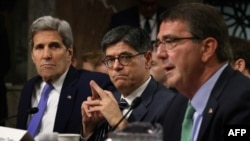
From left, Secretary of State John Kerry, Treasury Secretary Jacob Lew and Defense Secretary Ashton Carter testify before the Senate Armed Services Committee about the Iran nuclear deal on Capitol Hill, July 29, 2015.
Michael Bowman

U.S. lawmakers pressed top administration officials Wednesday for details on the international inspection regime that will enforce a landmark nuclear pact with Iran.

The officials, including Secretary of State John Kerry, Defense Secretary Ash Carter, Energy Secretary Ernest Moniz and the Chairman of the Joint Chiefs of Staff Gen. Martin Dempsey, testified before the Senate Armed Forces Committee to try to allay lawmakers’ concerns and convince them to approve the deal reached earlier this month in Vienna.

In a testy exchange consistent with Capitol Hill’s generally frosty reception of the deal, the chairman of the Senate Armed Services Committee, Republican John McCain, vented frustration over Congress’ inability to review agreements between Tehran and the International Atomic Energy Agency.

“Those protocols are very important,” McCain said. “We know that with any agreement with a country such as Iran, the devil is in the details.”
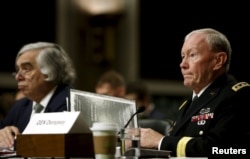
Chairman of the Joint Chiefs of Staff U.S. Army General Martin Dempsey, right, along with Energy Secretary Ernest Moniz, left, appear before the Senate Armed Services Committee in Washington, July 29, 2015.

In regards to verification documents being separately negotiated by international nuclear inspectors, Energy Secretary Moniz responded, “I personally have not seen those documents.”

McCain was quick to interject.

“To be honest with you, that is absolutely astounding that you have not seen the documents about the requirement for verification,” McCain said.

Moniz responded, “All I can say is that the agreement requires their (Iran’s) cooperation with the IAEA, and this is the standard practice of the IAEA, whose independence is very critical to all of us.”

'Record of cheating'

McCain was not finished.

“What’s critical to all of us, Mr. Secretary [Moniz], is that we have verification of and inspections of Iranian activities, because they have a clear record of cheating ... we should see those instruments of verification,” he said.

Moments later, Kerry addressed the topic, saying there is no side deal or secret agreements between Iran and the International Atomic Energy Agency. There are only technical documents that are standard practice and not released publicly.
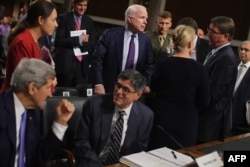
Senate Armed Services Committee Chairman John McCain, center, talks with, from left, Secretary of State John Kerry, Treasury Secretary Jacob Lew, Senator Kirsten Gillibrand, Defense Secretary Ashton Carter and Energy Secretary Ernest Moniz on Capitol Hill

"We are aware of what the basics of it are," Kerry told the committee members. "It is standard procedure for 189 counties that have an agreement with the IAEA. ... We don't get that. It is not shared with the world, but we do get briefed on it."

Nuclear agreement

Under the July 14 pact, world powers agreed to lift sanctions on Iran in return for curbs on a nuclear program the West suspects was aimed at creating an atomic bomb, but which Tehran says is peaceful.

Congress has 60-day period to review the Iran nuclear agreement, and committees in both the House and Senate have been questioning senior members of President Barack Obama's Cabinet, particularly Kerry and Moniz, who were part of the team that secured the deal earlier this month.

Wednesday’s hearing is the third in a week.

Senators of both parties also pressed the officials on Iran’s financial windfall from sanctions relief stemming from the nuclear pact, and its desire and ability to use new revenue to buy weapons.

McCain criticized the Iranian nuclear deal, saying it gives Tehran billions of dollars for a “shopping spree” on the international arms market.

McCain, a leading critic of the deal and the Obama administration, listed the timetable for Iran in purchasing weapons and arms: at year five, Iran will be free to acquire fighter aircraft, attack helicopters and warships; at year eight, it will be able to acquire material for more sophisticated ballistic missiles.
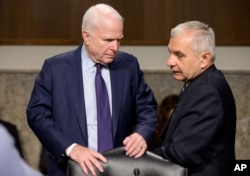
Senate Armed Service Committee Chairman John McCain, R-Ariz., left, talks with committee's ranking member Jack Reed, D-R.I., on Capitol Hill in Washington, July 29, 2015.

“Iran will not only have billions of dollars with which to go on a shopping spree in the international arms market,” McCain said, “but it is also sure to find plenty of states that are eager to sell those weapons, especially Russia and China.”

Iran's frozen assets

Treasury Secretary Lew noted that some of Iran’s frozen assets are held by banks around the world, and would likely be released at a future date even if Congress rejects the nuclear pact.

“This money is not sitting in U.S. banks. We can’t lock it up directly,” Lew said.

“We have worked bilaterally with countries around the world to do things against their own economic interests because they agreed with us on the imperative of stopping Iran from getting a nuclear weapon,” Lew added.

“If they see us walking away from an agreement ... I think the degree of cooperation we get goes down considerably," he added.

Provisions of deal

Days after tough questioning by lawmakers on the Senate Foreign Relations Committee, Kerry sharpened his response to criticism that the deal's provisions were temporary and would not prevent Iran from obtaining a nuclear weapon in the long run.
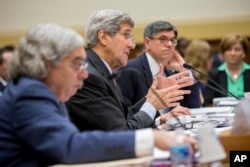
Secretary of State John Kerry, center, flanked by Treasury Secretary Jacob Lew, right, and Energy Secretary Ernest Moniz, testifies on Capitol Hill in Washington, Tuesday, July 28, 2015.

"Iran has agreed to refrain from producing or acquiring highly enriched uranium and weapons-grade plutonium for nuclear weapons forever," he told the House of Representatives Foreign Affairs Committee Tuesday.

​"When it comes to verification and monitoring, there is absolutely no sunset in this agreement. Not in 10 years, not in 15 years, not in 20 years, not in 25 years - no sunset ever,” he said.

Wednesday's committee focused on how the nuclear deal affects "U.S. interests and the military balance in the Middle East."

Defense Secretary Ash Carter and Dempsey, the top U.S. military officers, tried to blunt criticism of the plan and reassure lawmakers that U.S. forces would check Iran's "malign" influence in the Middle East should Congress green-light the nuclear deal with Tehran.

Carter, who toured the Middle East last week, defended the agreement, saying it is only one part of the U.S. strategy and that America is moving “full speed ahead” to confront Iran and the Islamic State group's malign activities in the region.

He told lawmakers that while the deal removes "a critical element of risk and uncertainty" in the region, U.S. forces will remain vigilant in maintaining Middle East stability and defending Israel, degrading and defeating the self-described Islamic State extremist group, and serving as a bulwark against Iranian hegemony.

"We will continue to maintain a strong military posture to deter aggression," Carter said.

"We're continuing full speed ahead, standing with our friends, standing up to ISIL, and standing against Iran's malign activity," he added, using an alternative acronym for the Islamic State group.
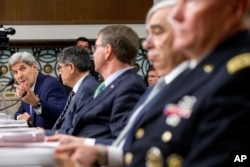
From left, Secretary of State John Kerry, Treasury Secretary Jacob Lew, Defense Secretary Ash Carter, Energy Secretary Ernest Moniz and Joint Chiefs Chairman Gen. Martin Dempsey testify on Capitol Hill in Washington, July 29, 2015.

Trigger arms race

Many Republicans and some skeptical Democrats have voiced concerns that the historic accord reached with the Islamic republic by six world powers, including the United States, would trigger a regional nuclear arms race, embolden and strengthen Iran, and put key U.S. ally Israel in jeopardy.

Dempsey said Wednesday that the recently signed nuclear deal works to keep Iran from having an atomic weapon, but does not address other concerns about Tehran's malign activities in the region.

“These run the gamut from ballistic missile technology to weapons trafficking, to the use of surrogates and proxies to naval mines and undersea activity -- and last but not least, to malicious activity in cyberspace,'' Dempsey told lawmakers.

“Ultimately, time and Iranian behavior will determine if the nuclear agreement is effective and sustainable,” he said, adding that he will continue to provide Obama with military options and will advise against reducing U.S. military force presence in the Middle East.

The United Nations Security Council approved the terms of the deal last week, setting off a timetable that could see sanctions lifted by the end of the year.
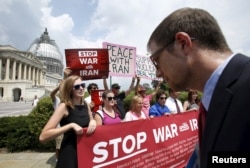
Activists deliver more than 400,000 petition signatures to Capitol Hill in support of the Iran nuclear deal in Washington, July 29, 2015.

Congressman Ed Royce, the Republican chairman of the foreign affairs panel, said Tuesday it is "backwards and wrong" that the U.N. voted on the pact before the U.S. Congress completes its review.

Royce also voiced skepticism about the agreement itself.

"Has Iran earned the right to be trusted?" he asked. "If this deal is approved, Iran gets a boost to its international stature.

"We appreciate President Obama's effort to secure the most intrusive inspections in history," Royce said. "But it came up short."

The lead Democrat on the committee, Congressman Eliot Engel, said there are "a number of issues" he finds "troublesome" about the deal.

"Fifteen years from now Iran will be essentially off the hook" for compliance with the agreement, Engel said, a contention Kerry rejected.

Congressional approval

Congress has until Sept. 17 to endorse or reject it. Rejection would prevent Obama from waiving most U.S.-imposed sanctions on Iran, a key component of the deal.

Obama has vowed to veto any congressional rejection measure, meaning both the House and Senate would need to muster two-thirds majorities to override the president and refuse to lift congressionally imposed sanctions.

Those sanctions, along with ones put in place by the United Nations and EU, came in response to allegations that Iran was using its nuclear technology to pursue nuclear weapons.

Iran has denied the allegations and insisted the nuclear program is peaceful.  It sought sanctions repeal as the main element of the agreement that limits its enrichment activity and subjects its nuclear sites to enhanced U.N. monitoring.

Some material for this report came from AP, AFP and Reuters.

You May Like

What You Need to Know About Benghazi Hearing

House committee on Benghazi was created in May 2014 to investigate causes of and responses to attacks on two US sites More

Will Cricket Score Points with Americans?

All-star cricket teams will hold matches in US cities in an attempt to spark American interest in the sport, which enjoys enormous popularity outside the US More

What Americans Fear More Than Terrorism

Americans are more afraid of this than they are of potential terrorist attacks, according to a new fear survey More

This forum has been closed.
Comment Sorting
Comments
     
by: Marcus Aurelius II from: NJ USA
July 30, 2015 3:48 AM
"US Lawmakers Seek Details of Iran Nuke Inspection Regime"

How in good conscience can anyone in Congress endorse this "deal" if they do not feel the administration has openly and freely supplied all of the details of how inspections are to be carried out on America's self declared enemy suspected of developing the most devastating weapons the human race has ever invented? What kind of person would agree to an arrangement that is either so full of holes or has been kept in part secret? Congress is not a rubber stamp for the administration the way Parliaments are.
In Response

by: Solaris
July 30, 2015 12:05 PM
XYZ affair happened as a result of disregarding the neutrality of the US by major powers Britain and France. do you suggest the the US should stay neutral today for instance in Iran's matter? if your answer is yes I agree with you. and again all terrorists are Sunnis, the Shiites may support them financially by conducting business with them. The US has supported some middle eastern terrorist organization during the cold war and that is understandable because polities are rather dynamic.

Saddam was a Sunni and France had the right to object invading Iraq under socialist government of Jacques Chirac which was not anti American but anti war, his successor was president Nicolas Sarkozy who became a supportive of US policies in the middle east. Try to read more about French culture and history because without it there would not exist an America today. The picture of general George Washington is still on the US one dollar bill and he was like secretary of state John Kerry a Francophile. and by the way change your name it does not suits you in my opinion.

by: Solaris
July 30, 2015 1:10 AM
France's foreign minister Laurent Fabius went to Tehran on Wednesday which proves that regime change in a Shiite dominating country will be through international diplomacy but not war. That is a victory for the United States and its true old friend : Republic of France.
In Response

by: Marcus Aurelius II from: NJ USA
July 30, 2015 8:35 AM
France is only a friend to the US when it is in trouble or wants something. We still have parts of the Alien and Sedition Acts on our books that were passed in the late 18th/early 19th century when the US almost went to war with France over the XYZ affair. DeGaulle was as anti American as he could be and France would have vetoed even a threat to use military force America and Britain wanted the UN Security Council to issue to Saddam Hussein if he didn't start to cooperate with UN inspectors.

France like Britain and Germany use the US to their own advantage when they need it but deep down have had nothing but contempt for it ever since the American revolution. Now Europe is desperate straits, It comes back to America showing its smiley face. I don't buy it. BTW, I lived in France for nearly two years so I have some understanding of the French culture and view of the world. Capitulation to terrorism to buy temporary peace is never victory, it is defeat. In the end it brings catastrophe. That is the lesson of WWII.

by: MKhattib from: United States
July 29, 2015 11:15 PM
This agreement is the worst of backroom deals. In addition to allowing Iran to keep its nuclear program, missile program, American hostages, and terrorist network, the Obama administration has failed to make public separate side deals that have been struck for the 'inspection' of one of the most important nuclear sites – the Parchin military complex. Not only does this violate the Iran Nuclear Agreement Review Act, it is asking Congress to agree to a deal that it cannot review. Secret annexes are not new in the world of diplomacy

by: Marcus Aurelius II from: NJ USA
July 29, 2015 7:31 PM
Israel will eventually come to America's defense and rescue by bombing Iranian nuclear weapons facilities just as it did in Iraq and Syria. America's spineless government is like a chained up gorilla. 800 pounds of muscle but all bark and no bite.

by: williweb from: Phoenix Arizona USA
July 29, 2015 12:20 PM
The Obama administration will do nothing when Iran violates the deal. The coming conservative Republican administration will be back threatening military action to enforce compliance like we were doing two years ago.

Featured Videos

Your JavaScript is turned off or you have an old version of Adobe's Flash Player. Get the latest Flash player.
Drug Kingpin El Chapo Guzman Injured During Searchi
X
Alberto Pimienta
October 19, 2015 8:34 PM
Mexican authorities are closing in on the most dangerous drug trafficker in the world, Joaquin “El Chapo” Guzman. “El Chapo” avoided being captured over the weekend but the Mexican government says he’s now injured. VOA's Alberto Pimienta reports.
Video

Video Drug Kingpin El Chapo Guzman Injured During Search

Mexican authorities are closing in on the most dangerous drug trafficker in the world, Joaquin “El Chapo” Guzman. “El Chapo” avoided being captured over the weekend but the Mexican government says he’s now injured. VOA's Alberto Pimienta reports.
Video

Video Kenyan Town Vies to Become East African Cycling Hub

The sport of cycling has steadily built a following in East Africa in recent years. It doesn’t hurt that two-time Tour de France winner Chris Froome was born in Kenya and trained by one of Africa’s best cyclists, David Kinjah. And now the town of Machakos, about 56 kilometers southeast of Nairobi, is trying to become Kenya’s, and perhaps East Africa’s, cycling hub. VOA’s Jill Craig has more from Machakos, Kenya.
Video

Video Taliban Remain Serious Threat in Provinces Around Kunduz

Even though Afghan security forces have regained control of the northern city of Kunduz from the Taliban after fierce fighting, the security situation in the region is still tenuous. VOA’s Ayesha Tanzeem traveled to Baghlan Province, neighboring Kunduz, and has this report on the situation there.
Video

Video Taiwan Finding Niche Markets in China’s Shadow

China’s economy is like a business magnet and as its influence grows its neighbors are finding it increasingly difficult to remain competitive. Like many economies in the region, Taiwan has been hit hard in recent years as China’s so-called “red-supply chain” has drained off talent and opportunities.
Video

Video Amid Congressional Leadership Crisis, Momentous US Fiscal Deadlines Loom

The U.S. Congress faces critical fiscal deadlines at a time of upheaval and uncertainty on Capitol Hill. Lawmakers are returning from a weeklong recess still wondering who will lead the House of Representatives. Michael Bowman reports.
Video

Video Egyptians Vote in Long-delayed Parliamentary Election

Voting in a long-awaited election for a new parliament opened Sunday in half of Egypt's provinces as the government works to complete a roadmap to democracy implemented following the ouster of the country's first freely elected civilian President Mohamed Morsi of the Muslim Brotherhood.
Video

Video Reparations Underway for War Victims in Ivory Coast, Many Still Awaiting

Five years after the deadly 2010 post-election violence in Ivory Coast, the country is determined to consolidate its peace. And to help in that reconciliation, President Alassane Ouattara created agencies aimed at providing reparation for war victims. The first batch of victims was compensated last August. But many are still waiting, and some are losing patience over the lagging process. Emilie Iob reports.
Video

Video Inter-Korean Family Reunions Preparations Under Way

A South Korean advance team that includes Red Cross officials is now in North Korea to prepare for next week’s reunion for families that have been separated by the Korean War. VOA’s Brian Padden reports from Seoul that this rare reunion, that just weeks ago looked unlikely to happen, will offer the 200 selected participants the first opportunity to see their families in over half a century. And it could clear the way to further inter-Korean cooperation.
Video

Video Vets: Syria Not Another Afghanistan for Russia

Russia's military strikes in Syria against enemies of President Bashar al-Assad have raised fears of a proxy war against U.S.-armed rebels. The concerns echo the Soviet Union's 1979 intervention in Afghanistan. Russian veterans of the Afghan War, however, say a similar conflict in Syria is unlikely as long as ground troops are not involved. VOA's Daniel Schearf reports from Moscow.
Video

Video Largest US Prisoner Release to Begin Oct. 30

The United States is beginning its largest prisoner release in history, now that federal sentencing guidelines have been reduced for certain drug offenders. VOA's Carolyn Presutti talks to an inmate who is counting down the days to freedom — and the people who don't think he's yet to earn it.
Video

Video Syrian Refugees in US Struggle to Start Anew

Communities across the United States are welcoming Syrian refugees who have fled their war-torn country and often spent many months, if not years, in refugee camps. But, as VOA’s Greg Flakus reports from Houston, some of their biggest challenges come as they try to adapt to life in a new country.
Video

Video Turkey: Europe’s Offer of Migrant Deal ‘Insincere’

European Union leaders have agreed on a plan to offer Turkey $3.5 billion, together with visa-free travel and renewed accession talks, in return for stopping the flow of refugees and migrants into the EU. But as Henry Ridgwell reports from London, the offer is getting a lukewarm reception in Ankara.
Video

Video Amnesty Accuses Saudi Coalition of ‘War Crimes’ in Yemen

The human rights group Amnesty International has accused the Saudi-led coalition of war crimes in airstrikes against Houthi rebels in Yemen. Henry Ridgwell reports the group says hundreds of civilians have been killed in strikes on residential areas.

VOA Blogs