



February is Black History Month in the United States, a time to recall the challenges and triumphs of African-Americans and to highlight their contribution to Americans of all races and ethnic groups.
Historically, the relationship between blacks and Jews has been both complex and fruitful and, recently, among the most strained. Recently however, a new musical revue explores their common ground.
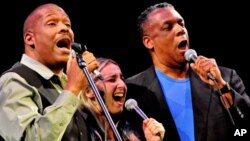
Cantor Magda Fishman sings a soulful Hasidic Jewish melody in Yiddish, the Hebrew and German-based language of Eastern European Jewry, that was spoken in Eastern Europe before the Holocaust, and in some American and Israeli communities today. It is followed tenor Tony Perry’s heartfelt rendering of a Negro spiritual melody from his own African-American tradition.
Those are just two magical moments in Soul2Soul, a musical revue produced by the National Yiddish Theater Folksbiene. The show explores common ground and shared spirit between Jewish and African-American musical traditions.
Folksbiene director Zalmen Mlotek, who created Soul2Soul, says African-Americans and Jews have both known centuries of oppression. When he heard Tony Perry and co-star Elmore James at an audition singing African-American spirituals and Yiddish folk songs about struggle, he wanted to build a bridge between the Jewish community and the African-American community. “And what better way to do it than through music?," he thought.
Mlotek was first exposed to African-American spirituals during the Civil Rights era of the 1960s. Many Jewish Americans were allied with the African-American struggle for equality, which often used spirituals as anthems. Some of those spirituals date back to the days of slavery and were based on stories from the Jewish bible.
Mlotek says that when he was a counselor at a left wing Jewish summer camp, the campers often belted out songs like “Oh Freedom,” and other spirituals, like the ones sung by both African-Americans and Jews in this show.
“This was a camp founded by Holocaust survivors who wanted their kids not only to learn Yiddish, but to live the values of caring for another people, of having respect for another people, of living in tolerance with other people. We woke up every morning singing songs for hours of the civil rights struggle with the same passion we sang Yiddish songs."
Soul2Soul co-star Elmore James credits the 1930s Yiddish recordings of the great African-American singer Paul Robeson as an early influence, as well as the Jewish culture he was exposed to.
“A history of a people is not measured by how much they suffer, but how they overcome suffering,” he muses. ”I think African-American culture and Jewish culture do share that in common: struggling against the odds. That’s what life is. I think these two groups have made an art form out of it.”