


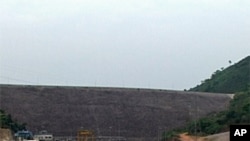
Sierra Leone's first hydro-power dam, almost 40 years in the making, was switched on in November 2009. It now produces 50 megawatts of electricity, sending regular power to most parts of the capital, Freetown. But transmission networks damaged during the country's civil war are so dilapidated that the capital can only absorb half of the dam's energy.
Nestled in the Sula Mountains in central Sierra Leone, the Bumbuna dam holds back 428 million cubic meters of water. Pressure from the dammed Seli river powers two massive turbines that provide a regular supply of electricity for the first time in the country's history.
Bockarie Vandi is one of the first Sierra Leonean mechanical engineers to work on the dam project. He says the dam at full capacity can actually produce twice the amount of electricity that Freetown's dilapidated networks can currently handle.
"At the moment our total capacity is 50 megawatts," said Bockarie Vandi. "But it is determined on the output that we give Freetown to take. If Freetown wants 20, we can give them 20. If they want 50 we can give them 50 - it depends on their network distribution. But for now we are giving them an average load of 27 megawatts at peak."
Much of Freetown's electricity infrastructure was destroyed during the country's decade-long civil war. Old distribution networks have not been maintained.
The National Power Authority says it is working to restore power to areas where old networks have failed and extend the grid to the rapidly expanding neighborhoods to the east of Freetown.
Generators still grumble a few times a week across Freetown. Even so, residents and businesspeople here say the hydro-power has changed life dramatically.
Akimatu Turay runs a streetside stall selling biscuits, sweets, and cigarettes under a large multicolored umbrella. Two bare bulbs strung from a nearby building light up his wares. For 25 cents, he will charge your mobile phone.
Turay says since the powerplant was switched on, he has seen many changes. Business is much better. In the past, he says, when there was very little light, he had to use a generator which cost him a lot of money. The lights still go off every now and again, but the money he saves on diesel, he says, he invests into his business.
Turay says his two lightbulbs are essential for attracting customers. And with an average income of $7 a day just from charging mobile phones, he is pleased with the new power.
Before Bumbuna, the country functioned on an emergency power plan costing $2 million a month to fuel diesel generators that produced only enough power to cover essential services. There is no national power grid in Sierra Leone leaving about 5 million people outside the capital to rely on costly generators.
Brima George runs an internet café in western Freetown. He is pleased with the new flow of electricity. A month's electricity supply now costs him what he used to spend for four days of power from a generator. But, he says, there is room for improvement.
"It's still in the hands of the government because we still hear that Bumbuna is not fully completed," said Brima George. "So there are some places that do not get current at all, some places get it time after time. So I think if the government can pay more attention and invest there more to complete it, I think. And satisfy the people because there are businesses that depend on the electricity."
With cheaper, cleaner and more regular electricity in the capital, the government does have plans to light up other areas of the country. The second phase of the Bumbuna dam project will build a larger reservoir upstream that could add more than 100 megawatts to the dam's capacity.
According to Vandi, this would be enough to cover greater Freetown and parts of the northern provinces.
But it will be costly. Unless the government can secure the entire investment cost of $520 million, the second phase could be a long time coming.
Related report by VOA's Scott Stearns