



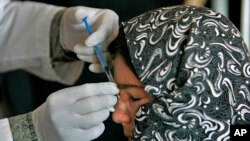
The painless but disfiguring lesions of cutaneous leishmaniasis, caused by the bite of a sand fly, may soon be treatable with an antibiotic cream. Developed by an international team of researchers, the cream would replace lengthy and painful drug treatments for the disease, commonly known as CL, in subtropical and temperate climates.
Right now, treatment for CL involves a 20-day course of drugs which contain toxic heavy metals that must be injected directly into a vein at hospitals and clinics. Public health workers in developing countries report some people infected with cutaneous leishmaniasis have tried to burn their disfiguring lesions with battery acid or red hot machetes rather than seek the medical treatment, which is painful, expensive and lengthy.
But CL patients could soon be treated with an antibiotic cream applied directly to the open sores.
Major Mara Kreishman-Deitrick of the US Army Medical Research Institute of Infectious Diseases is a lead author of a study of two antibiotic creams - one containing the drugs paromomycin and gentimicin and the other, paromomycin alone.
In a clinical trial of 375 people infected with CL in Tunisia, Kreishman-Deitrick says both creams, applied once a day for 20 days, led to a significant reduction in the size of the sores and improvements in skin regrowth after one hundred days.
“What we showed in our study, which we are very excited about, was that both creams that we tested cured more than 80 percent of the lesions in the patients that were treated, with a great safety profile," said Kreishman-Deitrick. "The side effects that we saw were mild and moderate and primarily just minor skin reactions around the application site.”
Further studies will be conducted to determine whether the cream actually kills the CL parasite, which is why investigators waited six months to see whether there was a flare-up of the treated lesions.
The Tunisian trial involved infection with L. major, a parasitic species carried by the sand fly in parts of the Middle East and North Africa. However, Kreishman-Deitrick is optimistic the combination antibiotic cream will treat CL in other regions of the world.
“Our animal data and preliminary clinical data show that we could see more of a difference in other species of leishmaniasis in parts of the world like Central and South America," she said.
An estimated 1.5 million cases of CL are diagnosed each year, including among U.S. military personnel serving abroad. Service men and women infected with leishmaniasis currently have to return home for treatment. Kreishman-Dietrick says the cream would allow them to be treated on site.
Because cutaneous leishmaniasis is considered a neglected tropical disease, Kreishman-Dietrick says U.S. regulators have put consideration of the highly-effective cream on a fast track for approval.
An article on the topical treatment for cutaneous leishmaniasis by researchers at the U.S. Army Medical Research Institute, the Tunisian Ministry of Health and investigators at the Instituts Pasteur in Tunis and in Paris is published in The New England Journal of Medicine.
Right now, treatment for CL involves a 20-day course of drugs which contain toxic heavy metals that must be injected directly into a vein at hospitals and clinics. Public health workers in developing countries report some people infected with cutaneous leishmaniasis have tried to burn their disfiguring lesions with battery acid or red hot machetes rather than seek the medical treatment, which is painful, expensive and lengthy.
But CL patients could soon be treated with an antibiotic cream applied directly to the open sores.
Major Mara Kreishman-Deitrick of the US Army Medical Research Institute of Infectious Diseases is a lead author of a study of two antibiotic creams - one containing the drugs paromomycin and gentimicin and the other, paromomycin alone.
In a clinical trial of 375 people infected with CL in Tunisia, Kreishman-Deitrick says both creams, applied once a day for 20 days, led to a significant reduction in the size of the sores and improvements in skin regrowth after one hundred days.
“What we showed in our study, which we are very excited about, was that both creams that we tested cured more than 80 percent of the lesions in the patients that were treated, with a great safety profile," said Kreishman-Deitrick. "The side effects that we saw were mild and moderate and primarily just minor skin reactions around the application site.”
Further studies will be conducted to determine whether the cream actually kills the CL parasite, which is why investigators waited six months to see whether there was a flare-up of the treated lesions.
The Tunisian trial involved infection with L. major, a parasitic species carried by the sand fly in parts of the Middle East and North Africa. However, Kreishman-Deitrick is optimistic the combination antibiotic cream will treat CL in other regions of the world.
“Our animal data and preliminary clinical data show that we could see more of a difference in other species of leishmaniasis in parts of the world like Central and South America," she said.
An estimated 1.5 million cases of CL are diagnosed each year, including among U.S. military personnel serving abroad. Service men and women infected with leishmaniasis currently have to return home for treatment. Kreishman-Dietrick says the cream would allow them to be treated on site.
Because cutaneous leishmaniasis is considered a neglected tropical disease, Kreishman-Dietrick says U.S. regulators have put consideration of the highly-effective cream on a fast track for approval.
An article on the topical treatment for cutaneous leishmaniasis by researchers at the U.S. Army Medical Research Institute, the Tunisian Ministry of Health and investigators at the Instituts Pasteur in Tunis and in Paris is published in The New England Journal of Medicine.