


A national project to highlight the contributions, successes and struggles of Indian-Americans is preparing to leave the virtual world and become an exhibit at the Smithsonian Institution in Washington.
“The HomeSpun project began a few years ago [online], with the goal of showing how American life has been influenced by Indian-Americans,” said Pawan Dhingra, the curator of the project.
Indian-Americans are often recognized for their contributions in medicine, software engineering and small business, but the exhibit will also put a focus on lesser-known fields where they’re making their mark, like music, literature, film, cuisine and politics.
“Indians are making a name for themselves in realms that I didn’t appreciate,” said Dhingra, who was born in India, but lives in the United States.
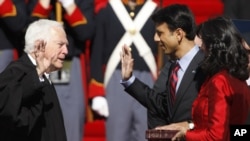
He pointed to Vijay Iyer, a highly regarded jazz pianist, Floyd Cardoz, a celebrity chef, and well-known politicians Nikki Haley and Bobby Jindal, the governors of South Carolina and Louisiana, respectively.
But the exhibit will also point out that Indian-Americans in politics is nothing new. For example, the exhibit will devote space to Dalip Singh Saund, a former congressman from California in the late 1950s and early 1960s who was the first Asian-American and first Indian-American elected to Congress.
Indian-Americans weren’t always so prominent. Dhingra said that in the 1970s and 1980s, it was very hard for Indian immigrants to become doctors, even though they were just as well trained and certified as their American counterparts. They reached out to other immigrant doctors to stem institutional discrimination and pave a path for future immigrant physicians.
That theme - working together to build better lives - will be on display at the Smithsonian.
The exhibit will also explore the less glamorous occupations undertaken by Indians in the U.S., specifically cab driving, long a staple career for many Indians. In New York, roughly 60 percent of cabbies are of South Asian descent, said Dhingra. They have such a big presence that in 1998, an Indian-American founded the New York Taxi Workers Alliance the nation’s largest taxi driver union.
Indians have a long history in America, coming to the U.S. as far back as the 17th century, although the first significant number of immigrants started to arrive in the late 19th century. Dhingra said these were mostly Sikhs who had come to work in agriculture and logging, primarily in Canada. After a major anti-Asian race riot in 1907 in Vancouver, Canada, many of the Indians began moving south into the U.S.
In 1917, when the U.S. passed a major immigration law preventing Asians from coming to the country, many of these mostly male Indians found it hard to get married or bring existing wives from India.
That law, Dhingra said, as well as laws preventing whites from marrying non-whites, led many Indian men to marry Mexican women who were also working in agriculture. The exhibit will show photos of these families as well as some of their personal belongings.
The exhibit will not only focus on the positive, Dhingra said. It will also explore domestic violence, which for cultural and immigration status reasons is common in the Indian community.
Because many Indian women are in the U.S. with visas tied to their husband’s, Dhingra said the “power dynamic between husband and wife can be extreme,” leading to potential problems.
To highlight the efforts made to stem domestic violence, the HomeSpun project worked with Manavi, the first organization in the U.S. to specifically address the needs of South Asian women victims of violence.
Lastly, the exhibit will display the turban of Balbir Singh Sodhi, a Sikh gas station owner in Mesa, Arizona, who was murdered in the aftermath of the September 11, 2001 attacks.
The exhibit, part of a larger Smithsonian initiative to highlight Asian Pacific Americans, is scheduled to open in Sept. 2013.
“The HomeSpun project began a few years ago [online], with the goal of showing how American life has been influenced by Indian-Americans,” said Pawan Dhingra, the curator of the project.
Indian-Americans are often recognized for their contributions in medicine, software engineering and small business, but the exhibit will also put a focus on lesser-known fields where they’re making their mark, like music, literature, film, cuisine and politics.
“Indians are making a name for themselves in realms that I didn’t appreciate,” said Dhingra, who was born in India, but lives in the United States.
He pointed to Vijay Iyer, a highly regarded jazz pianist, Floyd Cardoz, a celebrity chef, and well-known politicians Nikki Haley and Bobby Jindal, the governors of South Carolina and Louisiana, respectively.
But the exhibit will also point out that Indian-Americans in politics is nothing new. For example, the exhibit will devote space to Dalip Singh Saund, a former congressman from California in the late 1950s and early 1960s who was the first Asian-American and first Indian-American elected to Congress.
Indian-Americans weren’t always so prominent. Dhingra said that in the 1970s and 1980s, it was very hard for Indian immigrants to become doctors, even though they were just as well trained and certified as their American counterparts. They reached out to other immigrant doctors to stem institutional discrimination and pave a path for future immigrant physicians.
That theme - working together to build better lives - will be on display at the Smithsonian.
The exhibit will also explore the less glamorous occupations undertaken by Indians in the U.S., specifically cab driving, long a staple career for many Indians. In New York, roughly 60 percent of cabbies are of South Asian descent, said Dhingra. They have such a big presence that in 1998, an Indian-American founded the New York Taxi Workers Alliance the nation’s largest taxi driver union.
Indians have a long history in America, coming to the U.S. as far back as the 17th century, although the first significant number of immigrants started to arrive in the late 19th century. Dhingra said these were mostly Sikhs who had come to work in agriculture and logging, primarily in Canada. After a major anti-Asian race riot in 1907 in Vancouver, Canada, many of the Indians began moving south into the U.S.
In 1917, when the U.S. passed a major immigration law preventing Asians from coming to the country, many of these mostly male Indians found it hard to get married or bring existing wives from India.
That law, Dhingra said, as well as laws preventing whites from marrying non-whites, led many Indian men to marry Mexican women who were also working in agriculture. The exhibit will show photos of these families as well as some of their personal belongings.
The exhibit will not only focus on the positive, Dhingra said. It will also explore domestic violence, which for cultural and immigration status reasons is common in the Indian community.
Because many Indian women are in the U.S. with visas tied to their husband’s, Dhingra said the “power dynamic between husband and wife can be extreme,” leading to potential problems.
To highlight the efforts made to stem domestic violence, the HomeSpun project worked with Manavi, the first organization in the U.S. to specifically address the needs of South Asian women victims of violence.
Lastly, the exhibit will display the turban of Balbir Singh Sodhi, a Sikh gas station owner in Mesa, Arizona, who was murdered in the aftermath of the September 11, 2001 attacks.
The exhibit, part of a larger Smithsonian initiative to highlight Asian Pacific Americans, is scheduled to open in Sept. 2013.