Somali Farmers Call for Help to Improve Production
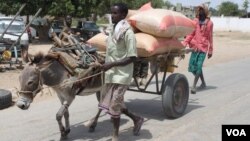
Business is booming in Balad, Somalia on July 3, 2012 after al-Shabab militants were pushed out of the city. (VOA/M. Yusuf)
BALAD, Somalia — Balad area in central Somalia is returning to normalcy after the farming town was liberated more than a week ago by African Union forces and Somali government soldiers. Now, residents in the town of Balad are ready to reclaim their livelihoods.
For nearly five years al-Qaida linked group al-Shabab controlled Balad, 30 kilometers northeast of Mogadishu.
An area known for its agriculture, al-Shabab routinely extorted money from farmers in the Shabelle region to finance their war against the transitional federal government.
One Balad resident, Ali Sheikh Ahmed, said farmers like him were forced to pay rent on their own land when al-Shabab was in control.
"For the past four years nothing was going on in this town, Ahmed says, al-Shabab did nothing to help the people, even though they were collecting money here. He said they never allowed humanitarian assistance to come in," said Ahmed.
Ahmed said he would like these farmers to be helped. He added that "the farmland here is productive. Any aid might not help them much. It is good if they produce their own food, and trust that their land will provide. To help them, it is good to put in more effort into farming."
Another resident, fruit seller Idhil Khalif Ali said al-Shabab forcerd her to leave town after accusing her of collaborating with the government. She said al-Shabab chased her away for two years, but now she is back. But during that time, she said, she did not see her home and children.
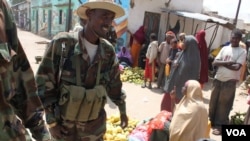
Women sell fruit at a market in Bala'ad, Somalia on July 3, 2012, as soldiers stand guard. (VOA/M. Yusuf)
"The reason they drove me away," she said, “was because they said I was working for the government, I was not working for anyone of them, but just my children. I am just a poor woman."
The stories of abuse and extortion coming out of Balad are part of a pattern repeating itself across the country, in areas under al-Shabab control.
But as the militants lose ground, small towns outside of Mogadishu are becoming busy again. People are returning to their homes and businesses. Fear and anxiety are slowly lifting as peace and security return.