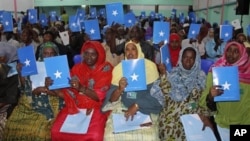
Somalia's constituency assembly members hold up copies of the proposed new constitution during the beginning of a nine-day meeting in Mogadishu, July 25, 2012.
NAIROBI — Somalia's National Constituent Assembly has overwhelmingly approved a new draft constitution, in a critical step toward ending the country's long political transition. The vote followed days of debate on some controversial clauses.
The constituent assembly passed the new constitution Wednesday with a vote of 621 in favor, 13 against, with 11 abstaining.
The constituent assembly met under tight security at a former police training center in the capital, Mogadishu.
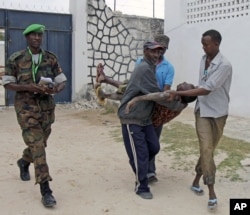
Somali police men in Mogadishu carry a soldier who was injured as two suicide bombers tried to blow up the constituent assembly venue before being shot dead by security forces, Aug.1, 2012.
Two suicide bombers attempted to enter the venue before the vote but were shot and killed by security forces. Authorities said at least one bomber detonated explosives during the clash injuring several security officers.
United Nations Special Representative Ambassador Augustine Mahiga said passing the new constitution moves Somalia closer to establishing new political institutions.
“I'm very happy and satisfied by the outcome of the vote by the constituent assembly to adopt the provisional constitution, which marks one of the major steps in ending the transition,” said Mahiga.
Somali leaders must select a new parliament and elect a new president before the U.N. mandate for the existing transitional government expires on August 20.
In addition to laying out the framework for the next government, the constitution also establishes Somalia as a Muslim country.
It also guarantees more rights for women, including the right to be included in all national institutions.
Members of the Somali community, including traditional elders, have expressed concern that allowing women to run for high office goes against Islamic law.
Others have expressed concern about divisions of power between federal and regional governments and other legal issues.
A member of the constituent assembly, Ibrahim Salah, told VOA he voted to approve the constitution, despite his objections to some of the content -- including the fact that it does not explicitly name Mogadishu as the federal capital.
“I voted yes,” he said, “because, we looked at the constitution over the last three days, after being broken off into groups, and we discussed all the clauses that the Somali people were not comfortable with.”
Special Representative Mahiga said the constituent assembly has “earmarked” some areas of the constitution for further discussion by the next parliament.
The new constitution will be provisional until approved through a national referendum.
In the next step in the political process, a group of traditional elders are to select members of a new parliament who will then elect a president and speaker.
Mahiga has warned of reports of aspiring politicians using bribery and intimidation to try to get a seat in parliament.
“I had expressed concern, and I continue to express concern, and issue warnings that these leadership positions have to be respected and the integrity of the process must be ensured,” he said.
Mahiga said corrupt practices are especially detrimental to women candidates, who have fewer resources.