


News / Africa

Somalia Urges Humanitarian Groups to Expedite Aid to Refugees

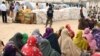
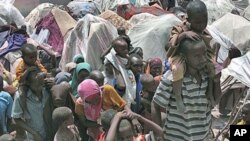
Somalis displaced by drought wait outside their makeshift shelters where tens of thousands have arrived in recent months desperately seeking food, water, shelter and other assistance, in Mogadishu, Somalia, July 25, 2011

Multimedia

Audio
  • Clottey interview with Omar Osman, spokesman for Somalia’s Transitional Federal Government (TFG)

TEXT SIZE - +
Peter Clottey

Omar Osman, a spokesman for Somalia’s Transitional Federal Government (TFG), described his visit Wednesday with Prime Minister Abdiweli Mohamed Ali to three refugee camps in the capital Mogadishu.

“The conditions Mohamed Ali saw were appalling,” said Osman, “and he could not believe that some of the U.N. agencies had not reached those camps.  At one of the camps we went to, we were informed that a child had died, just minutes before we visited.”

Relief workers say the Horn of Africa is experiencing the worst drought in six decades.  The U.N. and the U.S. Agency for International Development says more than 11 million people are in need of food aid.  Last week, the UN declared that famine has struck two regions in southern Somalia, which is under the control of the Islamic militant group, al-Shabab.

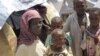
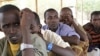
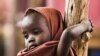
At the Dagahaley refugee camp in Dadaab, Kenya, families fleeing the famine in Somalia are given aid, but also face new challenges. VOA's Michael Onyiego visited the camp and took these pictures.

Osman said the TFG will continue its efforts to combat the effects of the drought despite inadequate resources.

“As you are aware, the government has tried to do its best with its meager resources... We have seen a real famine.  We have seen children close to dying even though the international community has politically pledged support to the Somali people to stop this hunger,” said Osman.

Definition of Famine:

The word famine is a term that is not used lightly by humanitarian organizations. The United Nations describes a crisis as a famine only when the following conditions are met:

  • Malnutrition rates exceed 30 percent
  • More than two people per 10,000 people are dying each day
  • Severe lack of food access for large population

Current Famine:

    Almost half of Somalia's population, 3.7 million people, are affected by the current crisis with malnutrition rates in southern Somalia the highest in the world, surpassing 50 per cent in some areas. The United Nations says it is likely that tens of thousands have already have died, the majority of those being children.

    The drought that has led to the current famine in parts of Somalia has also affected people in Kenya and Ethiopia.

    Previous Famines in the Horn of Africa:

  • Somalia 1991-1992
  • Ethiopia 1984-1985
  • Ethiopia 1974

He said agencies have been slow to provide famine relief.

“We urge the international community to speed up the process,” said Osman. “The situation cannot wait the normal procedure to take place. The situation is very urgent and dangerous.”

He said the prime minister has set up a committee to coordinate and assist international aid groups with their relief efforts.  Osman praised ordinary Somalis for helping their fellow countrymen affected by the famine.

“We have seen a lot of effort from the Somali people. Civil society groups and local NGOs [non-governmental organizations] together with the government and the local administration… have done a lot, and they have re-settled some of these new arrivals to a new camp,” said Osman.

He adds the TFG will continue its coordination with international aid groups to send “much-needed” help to refugees living in areas outside the government’s control, despite threats by hard-line insurgent group, al-Shabab.

The United Nations says "massive" action is needed to save millions of people living in the Horn of Africa from starvation.

Meanwhile, a donors' conference was reportedly scheduled for Wednesday in Kenya's capital, Nairobi.  The U.N. is seeking pledges of $1.6 billion to help the millions of malnourished people - many of them children.

You May Like

India, China Pledge to Overcome Border Tensions

Indian prime minister and Chinese premier attempt to move past tense standoff in the Himalayas during Delhi talks More

Burmese President Opens US Visit with VOA Town Hall Meeting

Ahead of his meeting with President Obama Monday, Thein Sein answered questions on human rights and economic development in his country More

Video Washington Week: Focus on Burma, US Government Scandals

President Thein Sein visits the White House on Monday, Congressional probes of multiple scandals are continuing More

This forum has been closed.
Comments
     
There are no comments in this forum. Be first and add one

Featured Videos

Your JavaScript is turned off or you have an old version of Adobe's Flash Player. Get the latest Flash player.
Video

Video Boston Bomber Spent 6 Months in Russia’s Most Violent Republic

The news of the Boston Marathon bombings circled the globe, and resonated here in Dagestan, a majority Muslim republic in Russia, on the shores of the Caspian Sea. Last year, Tamerlan Tsarnaev, the older of two brothers suspected of the bombings and a long-time Boston resident, returned to Dagestan, where he had lived for a year during his youth. Dagestan was the land of his maternal ancestors. But in the last two years, this republic of 3 million people has gained notoriety as the region with the highest level of political and religious violence in all of Russia. VOA's James Brooke reports from Makhachkala, Russia.