


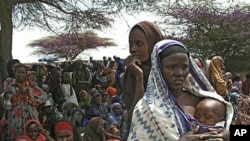
An official of Somalia’s Transitional Federal Government (TFG) is calling for “international intervention” to help his administration combat drought and famine, which has forced thousands of Somalis to flee to neighboring countries.
Last week, the president of Somalia and the United Nations declared that famine has struck two regions: Bakool and Lower Shabelle.
Government spokesman Omar Osman also accused the hard-line Islamic insurgent group, al-Shabab, of thwarting humanitarian relief efforts.
“The situation is very grave [and] for us, our action is very limited due to the extreme nature of the drought,” said Omar. “We have seen an influx of refugees or internally displaced people fleeing from regions controlled by al-Shabab moving to government controlled areas.”
Described by Washington as a terrorist group with links to al-Qaida, al-Shabab militants control much of southern and central Somalia, while the government controls only parts of the capital, Mogadishu.
Omar said the TFG is working closely with international humanitarian groups to help mitigate the effect of the drought, despite its meager resources.
“Our government has done a lot by mobilizing the resources that it has by bringing in more international aid agencies to Mogadishu and also appealing to the international community [for help, with] the prime minister personally taking the initiative,” said Omar.
Last week, the U.N. Refugee Agency said the death rate of starving Somalis reaching refugees camps in Ethiopia and Kenya is climbing, and the exodus of Somalis is continuing at a high rate.
But al-Shabab accused the U.N. of using the famine as a propaganda tool for political gains. The al Qaeda-linked insurgent group then vowed not to allow aid groups it has banned from operating in famine-stricken areas it controls.
Omar said there are reasons to believe that al-Shabab is purposely starving citizens in the areas the militant’s control as part of its agenda, which he said is to overthrow the internationally-backed government.
“The extremists are literally and deliberately starving the people to death, and that’s what we do not want. So, we need to [make] every effort to make sure that people are safe,” said Omar. “The root cause of the famine is the insurgency and the extremists. It’s very difficult to deal with. They are not allowing aid agencies to go to through.”
He adds that the TFG will continue its efforts to combat the effects of the drought.
Relief workers say the Horn of Africa is experiencing the worst drought in six decades. The U.N. has said more than 11 million people are in need of food aid.